December 30, 2020

Obituary: Gugudan closes another chapter in the Produce 101 book

Today we are starting a new series on this blog: Obituary. We are going to look at the history of groups who have disbanded. As Jellyfish Entertainment scheduled the disbandment of its long dormant girl group Gugudan for December 31st, they will be the first group to be talked about in this series.

It's impossible to tell Gugudan's story without mentioning "Produce 101". In the late stages of 2015, music channel Mnet announced a new competition show format. A total of 101 female trainees from multiple entertainment companies inside and outside of Korea would compete for 11 spots on a girl group, which would promote for a year. The concept of a survival show to form a group wasn't a new thing in the industry, but was largely restricted to the boundaries of one company, for example, in YG Entertainment's "Win: Who's Next?", which resulted in forming the boyband Winner. Or JYP Entertainment's "Sixteen", which formed girl group Twice. Interestingly, both shows aired on Mnet. In the end, a total of 46 companies, plus five individual trainees accepted the challenge.  Although many of them were small companies hoping to land one trainee that would improve their fortunes, many were long consolidated in the scene and had successful girl groups in the past. Cube Entertainment, home of  4Minute sent three trainees. DSP Entertainment, who had legendary girl groups such as Kara and Fin K.L, sent two. T-Ara's MBK Entertainment also sent a couple. Pledis Entertainment, known for its rotational girl group After School, sent a whopping seven trainees, which by themselves could form a group (and they later did). Sistar's Starship Entertainment sent a trio as well. And even though the Big 3 companies (SM, YG and JYP) were largely absent, the last one sent a lone trainee, 14-year old prodigy Ennik Somi Douma. The first release related to the show was the infectious "Pick Me", on December 17th, 2015, featuring 98 of the 101 contestants. The song became a sleeper hit, rising up the charts as "Produce 101" started airing in January 22nd, 2016, eventually peaking in the top 10 in the Gaon charts. "Pick Me" would also turn into the show's theme song, being performed and each of its following three seasons.
Produce 101 introduction press conference, January 21st, 2016

Among the companies not mentioned above, there was Jellyfish Entertainment. Founded in 2007, Jellyfish started its road on the industry by signing established ballad singers such as Sung Si Kyung and Park Hyo Shin. Their first incursion on the idol group business came in 2012 with the debut of boy band Vixx, formed from competition show "MyDOL", which aired, you guessed, on Mnet. Vixx found some success and would establish itself on the scene for their unique concepts. In the same year, Jellyfish hit big with its project "Jelly Christmas", established back in 2010, through the song "Because It's Christmas", featuring its full lineup of artists at the time. The project would score another #1 hit the following year, with "Winter Propose". By the time "Produce 101" arrived, Jellyfish had a longtime relationship with Mnet, which started when Mnet's parent company, CJ E&M, acquired 19% of its stocks in 2013 (later in 2017 it became Jellyfish's majority shareholder, before selling it back to the company's founder, Hwang Se-Jun). However, Jellyfish had no history whatsover when it came to female idols. Matter of fact, it had only two female singers on their roster, "K-Pop Star 4" contestant Park Yoon-Ha and former Jewelry member Park Jung-Ah, who at this point was focused on her acting career following her group's disbandment. Even so, both had been relatively successful, with Yoon-Ha even landing a #1 song from her "K-Pop Star" stint. Maybe such lack of tradition wasn't going to be an issue for "Produce 101" at all.

Jellyfish sent three of its female trainees to the show: Kang Mina, Kim Nayoung and Kim Sejeong. Turns out they had some hidden gems inside the company. The trio quickly emerged among the show's top contenders, with their introduction audition becoming the most watched of the show, scoring over 10 million views as of 2020. For the first 6 episodes of the show, all of their trainees were inside the top 11 debutants, making Jellyfish the only agency to accomplish such feat. Sejeong was the standout, becoming the top ranked trainee of the entire contest by episode 5. as she had stolen the show with her powerful vocals, taking center stage for a cover of  Wonder Girls' "Irony". Her battle for 1st place with JYP Entertainment's Somi would become one of the main storylines of the competition. Ultimately, Sejeong came in 2nd. However, by episode 8, the other two Jellyfish contestants had fallen out of the top 11, decreasing the odds of the full trio debuting. In the end, Mina managed to crawl back to 9th place and become the company's second representative on I.O.I, the temporary group formed at the end of the show. Nayoung, on the other hand, barely missed the cut, finishing 14th. 

"Produce 101" came to an end on April 1st, 2016. Just four days later, I.O.I dropped its first single, electropop track "Crush", who had been performed by the final 22 contestants in the last episode of the show. Mnet was in a hurry to present the new group to the public and initially intended to release it as the group's debut song. Ultimately, it decided that the song would serve as a pre-debut release, scheduling I.O.I's proper debut to May 4th, with an extended play, whose title, "Chrysalis", came up as a suggestion from Sejeong herself. The album would feature four new songs plus new recordings of the previously released "Crush" and "Pick Me". "Dream Girls" would serve as the title track. The song peaked at #7 on the Gaon Digital Chart. Individually, Sejeong continued to emerge as one of the hottest new idols in Korea, landing a gig on KBS variety show "Tales for Sale", where she once again impressed with her variety skills. Despite being a newcomer, she handed the spotlight on her with ease.

Jellyfish knew that too, they had a gem on their hands and wanted to capitalize on Sejeong's quick rise themselves. If Mnet rushed I.O.I as quick as they could, Jellyfish followed the same strategy for its new girl group and be the first company to capitalize on I.O.I's success. On June 7th, just a little over a month after I.O.I's debut, they revealed that their two members from the group would indeed be part of a new group. Two days later, Nayoug, their 3rd "Produce 101" contestant, was announced to also be a part of it. On June 13th, they first teased the group, under the name of "gx9", a reference to them having nine members, then the following days rolling out teasers introducing the members. Joining Sejeong, Mina and Nayoung would be members Mimi, Hana, Haebin, Sally, Soyee and Hyeyeon. The group finally debuted on June 28th, under the name of Gugudan, with their first EP, "Act 1: The Little Mermaid", with track "Wonderland" serving as their debut song.

To say "Wonderland" wasn't well-received is an understatement. The song was quite criticized for being a very generic track, being just another typical cutesy, high-pitched and aegyo infused song many groups had tried in that very same year: Gfriend, Twice, Oh My GirlApril, and obviously I.O.I themselves. Jellyfish clearly put their two I.O.I members front and center on the promotions, but it was of no avail. Gugudan was the ultimate generic group and that was its biggest problem. Also, by occupying Mina and Sejeong with its debut preparations, it created a headache for I.O.I, who wanted to continue promoting but had to do it under an incomplete formation. Their way to work around it was launching a 7-member subunit in August, which promoted the single "Whatta Man", sampling a 1968 song by soul singer Linda Lyndell, which also had been sampled by a girl group in the past, when Salt-And-Pepa did so in 1993. Missing from the unit were obviously the Gugudan duo, plus other two members who returned for promotions with their groups: Chaeyeon, who debuted for DIA in 2015, and Yeonjung, who had joined Cosmic Girls as their new member.

Gugudan spent the rest of 2016 largely dormant, as Sejeong and Mina went back to I.O.I. In October, the 11-member group released its last fully promoted comeback, the cutesy and fast-paced "Very Very Very", produced by none other than JYP Entertaiment founder Park Jin-Young. The song was very very very successful, giving I.O.I it's sole #1 hit and three of its four music show wins. Meanwhile, Sejeong kept bulding her popularity, landing a solo hit on the following month with "Flower Way", a ballad produced by well-known rapper and Block B member Zico, which peaked #2 in the Gaon Digital Chart and gave her a music show win at debut. She also closed the year with a participation on KBS' "Immortal Songs", showcasing her top-notch vocals once again. As expected, I.O.I disbanded in January 31st, 2017, releasing its final song, the farewell ballad "Downpour". Following the disbandment, Jellyfish acted quickly, announcing the release of "Act 2: Narcissus" for February 27th, with new single "A Girl Like Me", a girl crush concept with a retro beat. 

The new song was a big step up from "Wonderland" and a better fit to the group's members, playing to its strengths, particularly its abundance of good vocalists. It also fully embraced the group as being Sejeong and Mina's, considering both sing over 1/3 of the song. However, the negative impressions from the debut were a tough hurdle to come. Sales wise, Gugudan improved from its debut, going to 29 thousand copies, up from 22 thousand, but on the singles chart, the group essentially remained in the same position, as "A Girl Like Me" peaked at #38, down 3 spots from "Wonderland". In fairness, out of the groups with I.O.I members, Gugudan were the ones posting the best results, as Pristin, which debuted on the month after Gugudan's first comeback, and Cosmic Girls were charting around top 50. DIA themselves were charting top 80. Even as the hype from "Produce 101" started to wear out, Gugudan were still well-positioned as a mid-level girl group who could eventually rise with later comebacks, after all "A Girl Like Me" charted roughly similar to Oh My Girl's sole 2017 comeback, "Coloring Book" (which peaked at #37). However, considering we are writing a post about Gugudan's disbandment and currently Oh My Girl are one of the most popular girl groups in Korea, it's safe to say their careers went in quite opposite directions since. And indeed, "A Girl Like Me" would be the highest point of Gugudan's short lived history.

However, Jellyfish seemed to start giving up on the group, as Gugudan only had one activity on the following 9 months, the debut of subunit Gugudan 5959 (or Ogu Ogu), featuring members Mina and Hyeyon. Probably no one saw the writing on the wall better than its most popular member. As the group started to crumble, Sejeong knew she was at risk of becoming just an afterthought, long removed from the days of success at Produce 101, and started to take every possible opportunity. Even before the group's first comeback, she already had lined up a "King of Masked Singer" performance, a participation on the soundtrack of massively popular drama "The Legend of The Blue Sea" and joined reality show "Get It Beauty". A month later, she took part on variety show "Law Of The Jungle", partnering with BTOB member Sungjae. She also appeared on "Battle Trip", alongside fellow member Nayoung, with the show even taking a visit to Gugudan's dorms. Finally, she made her acting debut in July 2017 in the drama "School 2017", to which she got four nominations for "Best New Actress", winning one of them at the KBS Drama Awards. Mina also followed suit, debuting as an actress in October as the young version of the protagonist of "Children of the 20th Century". As its main members started to thrive outside the group, Gugudan finally made its comeback on November 8th, with their first single album, "Act 3: Chococo Factory", missing member Soyee, plagued by a longtime shoulder injury. "Chococo" was chosen as their main single.

The long hiatus clearly hurt the group, who went from charting top 30 to outside the top 100, with "Chococo" only charting in the domestic Gaon Digital Chart (where only Korean songs are included), at #95. It was the last time they charted on any Korean digital charts. Gugudan had lost any hype from "A Girl Like Me". The song in itself has its catchy moments, solid but not spectacular. Sales also went down, with the album selling 20 thousand copies. The music video definitely stands out for its rather bizarre nature. Interestingly, Jellyfish acted quickly this time and brought the group back less than 3 months later, with another single album, "Act 4: Cait Sith", dropping on February 1st, 2018. Soyee returned to the lineup. The new title track was the electro whistling "The Boots". The song is rather infamous for its line distribution, which sees Sejeong singing over 40% of it. Gone were the colorful outfits of "Chococo", replaced by black outfits and another 180 degree concept change. This time, it didn't move the needle, the song only managed to enter the Gaon Download Charts at #48, but didn't make the top 100 for the digital charts. The sales remained around the same number as the previous album, around 20 thousand copies.

In the following months though, the same pattern of 2017 repeated itself in 2018. Gugudan remained a dormant group, only releasing a subunit song, this time with their popular trio of Sejeong, Mina and Nayoung, called SeMiNa in reference to each member's first syllable of their names. The sassy and summery song, which carries the same name as the unit, clearly has Nayoung as its standout performer, between her high notes and her blonde hair and music video outfits. On the individual front, Sejeong continued her activities, becoming part of Netflix show "Busted", where she remains to this day, as the show is already on its 3rd season, which is expected for 2021 and once again she took part on a soundtrack of a popular drama, this time "Mr Sunshine". However, she wasn't the only member to enjoy a good year regarding solo activities, with Mina also rising as 2018 progressed. First she landed a gig as an MC for MBC's "Show Music Core". Later, she also landed her first main role, at drama "Tale of Fairy", including a kissing scene. She also appeared on the show's soundtrack.

Meanwhile, Gugudan's situation continued to deteriorate. Hyeyeon, who had been on hiatus since May, announced her departure on October 25th. In spite of this news, the group finally made its return on November 6th, which was, coincidentally, the day after Mina's new drama premiered. "Act 5: New Action", with the dancehall inspired "Not That Type". It would be the last time Gugudan made an appearance as a group.

They indeed saved the best for last. "Not That Type" has an addictive beat and does an excellent job in building up tension. The chanting chorus was something many girl groups have adopted since, but failed to come up with something as addictive and explosive as Gugudan. As girl crush has become the dominant concept for the past two years, "Not That Type" gets better, as it remains one of the last great songs tied to such concepts. Every new generic girl crush track that drops enhances it, which is quite funny when you consider Gugudan were the ones who started their careers being labeled as a generic group. Its disbandment was a quite obvious outcome, considering their hiatus had already lasted for over 2 years, and especially following the news from member Sally, saying Jellyfish told them to leave their dorms. It closes another chapter in the history of "Produce 101", alongside Pristin's disbandment last year. It leaves Weki Meki as the last remaining group with I.O.I members who debuted following the show's ending. 

However, not everything on their history is sadness and the feeling that they were just another girl group who couldn't make it and fell due to negligence. In the end, three of its members managed to build careers who will allow them to remain active for some years. Sejeong is the obvious example. Becoming bigger than the group (which was probably true from its start) ended up being a blessing for her. She resumed her singing career,  first with a new single, "Tunnel", in December 2019, then releasing her first album, "Plant", on March 17th, 2020, followed by another single in "Whale". Simple ballads that display her same great vocals that made her popular in the first place are her bread and butter. But her last successful venture is a fairly recent one, as she is currently acting in the drama "The Uncanny Counter", which has become a sleeper hit, seeing its ratings rise every week. And yes, once again she participates on the soundtrack. Mina stayed for over two years on her gig as a MC for Music Core, parting ways with the show only May 30th, 2020, ending the final link between the group and the idol scene. She also followed the footsteps of Sejeong, participating in a season of "Law of the Jungle" in 2019, which was followed with a supporting role on top drama "Hotel Del Luna" (and another kissing scene). Mina is still only 21-years old, which means she has time to build on her acting career. Last, there is Sally. The Chinese member, which was largely forgotten when part of the group, returned back home, where she joined competition show "Produce Camp", placing 6th and debuting on new group "Bonbon Girls". It is the end of the line for Gugudan, but definitely not for its former members.

Gugudan: June 28th, 2016-December 31st, 2020.

December 25, 2020

A 2020 girl group restrospective: the year of "Oh My Pink"

It's safe to say the year of 2020 has largely been wrapped up for girl groups (and idol groups in general). Most music shows have already ceased activities, leaving only a few awards and the traditional end of the year performances at the Gayos to finish the year. New music, however, will most likely only come out in 2021 and with that in mind we turn our attention to a specific collective of idols who are going to have a quite decisive year as a whole for next year: girl groups.

To understand 2020 first we have to rewind to 2019, which was an abysmal year for girl groups in Korea. It set many negative records and was the first time a girl group failed to score a #1 song since the inception of the Gaon charts in 2010 (and most likely since all the way back in 2006). The year, which had a promising start, with newcomer Itzy delivering what ended up being the biggest girl group song of that year, ended up peaking quite early. Top groups Blackpink and Twice made their returns in April and underperformed their 2018 results, same for Mamamoo a month earlier, but in hindsight their charting performance was actually good compared to what came up next. Historically speaking, girl groups best season is summer, where they use to dominate the charts with catchy songs perfect for the season. It wasn't the case for 2019. Matter of fact they struggled hard and collected one chart failure after another. Their songs were replaced by ballads in the charts. Red Velvet's two summer releases of 2019 were much less impactful to their 2017 and 2018 songs at the same time of the year. Itzy, who were the new sensation early in the year, also underperformed with their first comeback. Even all the way up to September the situation hadn't changed much. Twice made their second comeback during that time and scored the worst charting of their careers. It seemed like Koreans had completely shifted away from girl group music and fully turned their backs on them.

However, girl groups found an unexpected source of help in the final stages of the year: Mnet's competition show Queendom. Mixing a lineup of popular established veterans such as Park Bom, AOA and Mamamoo, newcomers such as (G)I-DLE and groups making their last attempt at a breakout in Lovelyz and Oh My Girl, the show offered a second chance for these groups to intoduce themselves to the audience or remind them about whom they were. Ir didn't register top-notch ratings but many of its performances gained steam after initial airing, particularly during the cover rounds, which saw AOA perform Mamamoo's "Egotistic", and Mamamoo retributing the favor with a cover of "Good Luck", but if the veterans made noise, the ones who benefited the most were the groups with less recognition among the audience, namely (G)I-DLE, through their cover of 2NE1's classic hit "Fire" and Oh My Girl magestic cover of Lovelyz's "Destiny" in traditional Korean outfits. Obviously, not everything was good, Lovelyz cover of Brown Eyed Girls' "Sixth Sense" drew a decent amount of criticism, but overall the show managed to reintroduce girl groups to a broader audience.

It was not a coincidence that once the show ended, girl group chart improved massively in the last couple months of the year. (G)I-DLE's Queendom single "Lion" gained a surprising amount of traction and did much better than the group's first two releases of the year, "Senorita" and "Uh-Oh", which failed to match their 2018 results from a solid debut in "Latata" and its follow-up "Hann". Mamamoo held its second comeback of the year shortly after the end of Queendom, with its single "Hip" becoming the first big hit scored by a girl group in more than 7 months and enjoying great longevity. At the 2019 Melon Music Awards Mamamoo were the only girl group who won their "Top 10" bonsang, given to the artists with the best digital performances in the year. Even non Queendom participants such as Red Velvet enjoyed a resurgence, with the group's last second release "Psycho" topping the charts just as the year was about to end.
It seemed like the days of girl groups being ignored were left behind, and 2020 seemed to be off to a promising start. With "Psycho" and "Hip" solidly sticking at the top of the charts, new groups kept joining the fold. Iz*one scored the biggest hit of their careers with "Fiesta", after a comeback that was long delayed due to scandals related to the group's formation at competition show "Produce 48". Itzy while failing to match their debut results, had a bounce back with "Wannabe". In April, 9th year veteran Apink scored its biggest hit since 2014 with "Dumhdurum". If (G)I-DLE initially didn't capitalize on their Queendom hype with "Oh My God", later in the year they got their song with the best longevity of their careers so far in "Dumdi Dumdi". However, the year clearly had two protagonists, which came from groups with quite opposing career trajectories: Oh My Girl and Blackpink.

Oh My Girl never had a history of being a top charting group. They were a solid mid level girl group but one that always lived in the shadows of other bigger groups. That all changed in 2020 with the release of "Nonstop" and a surprising hit coming from a b-side track in "Dolphin", who eventually even surpassed the original single in success. They were another example a girl group who suddenly rises onto star level fame while no one is expecting it, as we saw in the past with groups such as Girl's Day in 2013, AOA in 2014, Exid in 2015 and Momoland in 2018, which is then followed by the audience falling in love with the charms of one member which sees her popularity skyrocket: Hyeri, Seolhyun, Hani, Yeonwoo and, in Oh My Girl's case, Arin. Blackpink, on the other hand, were popular from the start. Coming from YG Entertainment, a machine of churning out hits, home of legends such as Bigbang, 2NE1, Psy. The group was breaking records at debut. In the same year they managed to get close to chart on Billboard's Hot 100 before even their first anniversary, Oh My Girl was losing a member. One largely makes cute songs, the other has become synonymous with the girl crush concept in the recent years. The two groups couldn't be more different but 2020 converged both onto the same spot: the two main girl groups of Korea. 

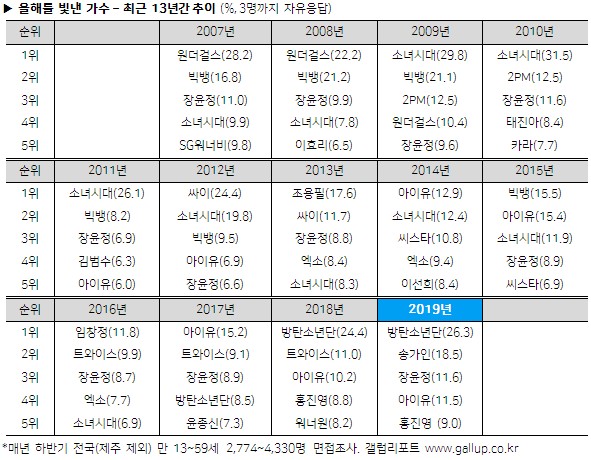
However, despite its initial advantage, Blackpink had a quite complicated 2019 which nearly put in jeopardy their past achivements. The year which started on a high with a successful world tour highlighted by their performance at the Coachella festival, ended up on a very low note, with the group largely hiding from the spotlight and dealing with scandals hurting the image of its label and controversies leaving a scratch on the group's overall image. The result was a loss in popularity in Korea, which can be picked up by their results on Gallup's 2019 survey of the most popular artists, idols and songs. Compared to 2018 the group dropped from 8th to 17th, saw members Jennie and Jisoo go from the 2nd and 10th most popular idols in 2018 to 8th and 17th most. In 2018, the group's summer hit "Ddu-Du Ddu-Du" was the first girl group song since Girls' Generation's "Hoot" back in 2010. However, their 2019 single "Kill This Love" didn't even register. For the first half of the year that seemed unlikely to change, given the flashbacks of past years of false promises of a comeback that kept getting delayed. Eventually, the group, already known for extremely long hiatuses, ended up having the longest of their careers. Their story, though, has a nice ending for 2020, with both "How You Like That" and "Lovesick Girls" becoming hits, leading to their domestic popularity bouncing back and to their full consolidation as the main girl group on a global scale.
On the other hand, 2020 wasn't such a great year on many fronts for girl groups. If Blackpink and Oh My Girl managed to be standouts, there were also many negative results. One of them is the decline of veterans such as Twice, Gfriend, Red Velvet, AOA and Mamamoo. None of these four managed to score a true hit this year. Twice maintained their slide from 2019, with both "More & More" and "I Can't Stop Me" being their worst performing songs. Gfriend has essentially become a mid-tier group, long removed from the days of smashes such as "Me Gustas Tu" and "Rough". It's arguable that the group has never been as good musically as in 2020, with all three of their singles, "Crossroads", "Apple" and "Mago" being great songs, but none of them couldn't even chart in the top 30. Red Velvet did not have a comeback as a full group in 2020, with the accident suffered by member Wendy in late 2019 and the scandal hitting member Irene in October of this year as major factors. "Monster", their subunit release featuring only Irene and Seulgi, did alright, but a far cry from "Psycho". Speaking of scandals, 2nd generation veterans AOA essentially ended their career as a group on a awful note, with their leader Jimin leaving the group following accusations of bullying from member Mina, who departed in 2019. Mamamoo, who largely had individual activities, with three of the four members releasing solo albums, only held a group comeback in the final quarter of the year, with pre-release track "Dingga" doing better than the actual single "Aya" but none matched the results of "Hip". On the meantime, member Hwasa's solo career seems to be headed on a very solid direction, as she landed another solo hit with "Maria" and participated on the Refund Sisters project alongside rapper Jessi and legends of Korean pop music such as Uhm Jung Hwa and Lee Hyori, which was also a success, consolidating her as one of the top idols in the country.
Also, the rookie class of 2020 was particularly weak, even more so than 2019. Weeekly, who come from the same company as Apink, took most of the rookie of the year awards, but the group barely charted inside the top 1000. Groups like Cignature, Secret Number and Woo!Ah weren't even able to do that. The best results came later in the year, with StayC, from the newly formed label crated by producer Black Eyed Pilseung, managing to chart in the top 200 of Gaon's digital chart with their debut song "So Bad" and SM Entertainment's new girl group Aespa, which charted top 50 with "Black Mamba". They were essentially the only rookies who managed to chart on Gaon's digital chart (which is made of 200 songs), no one else did. Given their debut came past the eligibility window for 2020 awards, they will only run for rookie of the year in 2021. Aespa's debut itself was very complicated, having to deal with SM artists controversies, bad rumours, plagiarism accusations and overall lack of goodwill, meaning the group starts way behind its predecessors such as f(x) and Red Velvet at their respective debuts, counting on upcoming releases and the public knowing its members better as a way to improve results in 2021.
Overall 2020 ends on a mixed bag for girl groups, with many questions open for next year: will veteran who had down years bounce back or will their careers just wane until disbandment or hiatus arrives? Will Blackpink and Oh My Girl carry their results from this year to 2021? Will the rookies and young girl groups improve in general? Will we get a better rookie class in 2021? We can't answer them now, only speculate. For the next article, that's exactly what we are going to do. So stay tuned.

December 08, 2020

Award shows: increasingly a bubble

On saturday, December 5th, and Sunday, December 6th, two award shows were held in Korea: the Melon Music Awards (MMA) and the Mnet Asian Music Awards (MAMA). These awards that once saw historical performances, have been losing relevancy each year and increasingly confining themselves into a bubble where they chase the audiences of specific fandoms rather than the general public.

Melon Music Awards continued its struggle of having fewer artists each year who are crowned among the top 10 artists of the year by the platform. In 2020, only 4 of them attended the award: BTS, Iz*one, Lim Young-woong and Oh My Girl, a decrease from 2019, which saw just half of the awarded artists appearing on the ceremony, and way behind the years from 2016 to 2018, where 8 of the 10 selections decided to attend. Matter of fact, 2020 became the first time since the inception of the award  back in 2009 where less than half of those selected went to the show.

The show altered its structure of one night of awards to a four-day online broadcast dubbed as "MMA Week". It speaks volumes about the lack of interest on the show that not even a cable network showed interest on broadcasting it, as opposed to past years when JTBC took the duties of showing it on television. Days 1 to 3 even felt like an attempt to shrink the main ceremony, by giving some minor awards in advance such as best original soundtrack and best new artist. In the end the lack of performers willing to attend the show was so concerning that Melon had to call boy bands who didn't even get any nominations such as TXT, Monsta X and The Boyz to fill the award and also as an attempt to attract a more fandom based audience to stream the award. TXT even got the 2nd most performance time only behind their seniors BTS. In fairness to MMA at least the show wasn't essentially a BTS solo concert like in 2019, with the popular boy band performing for 20 fewer minutes than last year. The running time of the award was also nearly cut in half, going from 4 hours over the past few years to just a little over 2 hours and 10 minutes in 2020.

On the following day, Mnet, Korea's top music-oriented channel, held the 22nd edition of its music awards. MAMA, as its mostly known, has suffered a huge decline in prestige when acts of what's called the 2nd generation of k-pop largely left the scene and gave room for 3rd generation acts. You can pinpoint on the graphic exactly where this happened, as MAMA ratings took a tumble from 2015 to 2016 and never recovered. Even the small bounce backs in 2017-18 due to the fact that the public at least got accustomed to such new artists and these acts popularity in Korea increased over that span, it still resulted on ratings 50% lower than the heydays of the show. In 2020, it wasn't any different, matter of fact MAMA ratings tied 2016 for the lowest ever, posting a 1.2 rating for the ceremony.

For 2020, Mnet's bet was the return of SM Entertainment artists to the lineup. The label, who had been absent from the award since 2017 and even pulled out from Mnet's weekly music show MCountdown in 2018, had finally made amends with the channel. The first movement came earlier this year when Girls' Generation member Hyoyeon joined the lineup of Mnet's new show "Good Girl". By the time SM's new main boy band NCT had made their 2020 comeback, SM had already fully made peace with Mnet and they were able to perform on MCountdown.

The SM lineup brought to MAMA in 2020 was quite different from that one they had in 2017. Gone were Exo and Red Velvet, the main groups of the company back in the day. In was a mix of old and new, with Shinee member Taemin and legendary singer BoA representing the former, while groups such as NCT and Aespa (through its member Winter) representing the latter. In predictable fashion, SM made everything on their power to make NCT stand out: all their subunits had performances under a themed stage called "Resonance of NCT". The group actually got more performance time than BTS itself, spending over 22 minutes on stage. However, the most buzz out of any SM performance went to BoA's 20th Anniversary Special, with the singer getting both a tribute stage and an individual performance that drew many praises.

However, amidst so many 10-minute long performances, turns out it was the one with the shortest screen time that made the most waves: the collaboration stage between (G)I-DLE (Soyeon, Soojin and Yuqi) and Oh My Girl (Mimi, Jiho and Arin) members to perform Miss A's classic "Bad Girl Good Girl". Despite it being just 2 minutes long, it was the stage that trended the highest in Korea and even earned the support of a Miss A member Fei. The performance being the most trendy of the award shouldn't surprise anyone, considering that both groups were one of the few attendants of the show who had reached audiences besides their fandom bubble and had quite good chart performances in 2020, particularly Oh My Girl, who emerged from a mid-level girl group status prior this year to scoring two hits in "Nonstop" and "Dolphin". (G)I-DLE also had a decent performing song of their own in "Dumdi Dumdi", which has so far been their song that has lasted the longest on Korean charts. Both groups have members with good public recognition, something that can't be said of many boy bands who got more performance time than them such as Ateez, Cravity and Treasure, which in many cases struggle to even chart in the top 1000, proving how MAMA and other awards have increasingly become a fandom-oriented bubble. By the way, all these three boy bands got at least one award from Mnet, meanwhile, (G)I-DLE and Oh My Girl were shut out despite being way more successful.

Finally, it isn't MAMA if there is no controversy. The one from this year is the fact that idols and their staffers were left to wait in the cold before their performances, given no waiting rooms were provided, with some of them having to wait inside their cars. Meanwhile, actors had comfortable waiting rooms. It's not a secret the difference in perception between actors (who are worshiped) and idols (who are considered the lowest level of entertainers) in Korea. This one just highlights the hierarchy inside the industry perfectly and of course it had to come from the award where controversy is not a bug but rather a feature. 

In conclusion, the more awards have catered to fandoms, the more irrelevant they have become. And they aren't the only ones, since that's an industry-wide movement. The choice for inflated sales by milking fans to the last drop as opposite to try to find a more casual audience has turned the idol world into a bubble the average music listener at their own country is less familiar with each day. Quite a difference from the years of the 2nd generation where many pop stars were household names.

PS #1: I mentioned SM Entertainment's return to MAMA but they weren't the only label from the now archaic Big 3 to make its comeback to the show. YG Entertainment, the k-pop company version of a pain in the ass, also made its first appearance on MAMA since 2015, when it ruled the night with big performances from Psy, 2NE1 and that night's biggest winners Bigbang. They brought their globally popular girl group Blackp... wait, who am I kidding? They brought their new shining toys Treasure, who are the first YG group in history to chart like they are from some garage label.

PS #2: I feel bad for Weeekly. They took rookie of the year on the girl group side on both awards but didn't touch the stage in any of them, only did acceptance speeches. This must be a first. Sums up how sad the situation of the 2020 girl group rookie class is right now. All that while having to deal with the anger of Secret Number fans. Between this, the main girl groups from 2020 debuting after eligibility for the awards had expired and the overall anonymous status of the group, there isn't much to celebrate.

PS #3: here are some pictures of Girls' Generation (former?) member turned actress Sooyoung on her stunning red carpet dress at MAMA. They don't have any context related to the article aside from the fact that she took part at the awards but given how beautiful she looked I decided to leave a few here. So beautiful she should win a daesang.

December 06, 2020

Melon's all-decade list just erased an entire generation from history

On December 1st, Melon, Korea's top music platform, published its long awaited list of the most popular songs of the 2010s decade in the streaming site. Some usual suspects were there, such as Busker Busker's "Cherry Blossom Ending", the only song to ever get a triple platinum download certification, scoring over 7.5 million downloads, and a song that has become associated with spring in Korea. Same for Ailee's "I Will Go To You Like the First Snow", the most downloaded song from a Korean original soundtrack. The country's most popular singer, IU, landed the most songs overall on the list with 11, including two top 10 solo entries in "Through The Night" and "Friday" and a feature in the also season-themed "Not Spring, Love or Cherry Blossoms" by one-hit wonder band High4. The importance of the list can be seen right there when checking the comments left by people on the music video of "Cherry Blossom Ending" talking about its coronation as the "song of the decade". Also, the list has been used to push many narrative about certain artists being the "nation's [insert term]": group, soloist, darling, first love, boy group, girl group, pride, you name it.

That being said, the list is quite bad and has some glaring omissions and suffers from some glaring recency bias to a point it feels like it only features Melon's best songs from only the 2nd half of the decade.. To start, here is a song that was left out of the list, some might argue it's not known enough to be part of a top 100 songs of the decade, so I'll leave it to the reader to decide.

Yes, that's right, the song in question is none other than Psy's smash hit "Gangnam Style". Contrary to the popular belief that this song was essentially a viral novelty song that only caught fire among international audiences and essentially turned into the Korean equivalent to "Macarena", it was actually quite popular domestically, scoring 816,868 downloads during its release week, the 2nd most of 2012, topped the charts for five straight weeks and won a grand total of a 20 music show trophies. It's particularly troublesome that Melon had such a big amnesia over it when the platform itself chose it as "song of the year" at their 2012 edition of their music awards. Psy actually had a song on the list, which was... a b-side from the album that contains "Gangnam Style".

Now what about the fact that your group was so dominant for such a long time it set the record for most consecutive #1 hits, three of them crossing the 3 million download mark, achieving it during a six-year span, showing how consistent your chart dominance was, to a point that when a certain season of the year arrived, it was expected for them to release a chart topping song, and they never failed. That was probably enough to land at least one of them in an all-decade top 100, right? Well, the answer is: wrong.

Exactly, despite being one of the most consistent idol groups of the decade, Sistar, the "Queens of the Summer", landed a grand total of zero songs on the list. Breakout hit that sold over 4 million downloads "So Cool"? No. 2012 chart toppers who were downloaded over 3 million times "Alone" and "Loving U" that made Melon itself gave the group a top 10 award and nominate the quartet for artist and song of the year awards? No. Follow-up summer hits "Touch My Body" and "Shake It"? Nope.

That being said, if you are the group who has the most songs over 3 million downloads with four, all of them in the 2010s, including the most downloaded idol song of the decade, at least one of them will make it, right? Nope. The group in question also got shut out.

Even though no idol song had as many people buying it in Korea than T-Ara's "Roly-Poly", and the fact that the song is still relevant to this day, as shown by the performance above, which marked the first reunion of the group since 2017, going viral, it was still not enough for Melon to make it one of the biggest 100 songs of the decade. Same for the group's other smashes such as "Cry Cry", "Lovey Dovey" and "I Go Crazy Because of You".

What about the "nation's girl group" itself, Girls' Generation? After all, Melon crowned their signature hit the song of the 2000s in Korea, despite it being released in 2009. Even follow-up single "Genie" made the list despite being a six-month-old song. They were also shut out, despite the success of songs such as "Oh!", "The Boys" and their first sub-unit song, all of them also among the best-selling songs of the decade, wasn't enough as well. The group who was voted for 10 straight years (7 of them in the 2010s) as one of the favorite artists by Koreans, apparently wasn't impactful enough during said decade.

What about other groups? Bigbang had so many hits, no way they forget songs such as "Fantastic Baby" and its 4 million downloads? Well, turns out Bigbang only managed to land one song on the list, its 2015 hit "Bang Bang Bang" and probably because the song had over 100 million streams, and Melon seemed to have over prioritized streams even though they only grew recently and can be manipulated by fandoms (pretty much all the songs pre-2016 that made to the list had a platinum stream certification). Miss A's "Bad Girl Good Girl" was a quite successful debut, it remains to this day the only debut song to win a "song of the year" award, also out. 2NE1 and their 9 number one hits? Also shut out. At this point you have got the drill, the first half of the decade essentially didn't exist to Melon on their list.

Overall, Melon's ranking seemed to have suffered from a quite blatant recency bias, rewarding any song who got a platinum download certification from 2016 onwards but ignoring many who did it earlier in the decade, especially the ones from 2010-13, where most of the examples mentioned on this article come from. As you see from this chart, two years by itself (2016 and 2017) comprise 43% of the list. Meanwhile, the first four year of the list only combined for 17 songs, fewer than both 2016 and 2017 by themselves. 2013, which was the year the price of downloads suffered a major increase in Korea, features only one song, proving Melon didn't adjust to the new conditions, while also punishing most of the songs with big downloads before that change. In 2014 they overcompensated and put nearly every big hit from that year on that list, after a decrease in 2015, 2016 and 2017 had nearly all their top hits make the ranking.

This looks particularly awful when compared to Melon's own 2000s list, which is quite evenly distributed throughout the decade. The year with the most songs on the list, 2003, had 13 entries. In the 2010s list, 3 different years had more and 2015 was just one song away from tying it. Meanwhile, the years with the fewest entries (2005 and 2007) had 8 songs, which was the same as 2010, 2011, 2013 and 2019 combined and just one below 2012. Melon even took the risk of having some recency bias on the list by including 10 songs from 2009, including the #1 (Girls' Generation's "Gee") but that actually proved to be a wise decision. Oddly, it seemed to have forgotten that the years it largely ignored in this decade's list were essentially a continuation of the trends started in 2009. Meanwhile, in the 2010s list the site didn't have the guts to include a single song from 2019, a massive u-turn.

Even compared to Billboard's own choices to their all-decade's Hot 100, Melon's chart still looks imbalanced. Billboard took an approach where the results pointed out to some great years such as 2011 and 2018 (albeit this one might have been aided by some recency bias) and some down years such as 2016. At the tails of the distribution it had four songs from 2009 that blew up during the 2010s and the same number for 2010. It had a slightly larger variance than Melon's 2000s top 100 even if you exclude the first and last years, but not even close to the travesty that was Melon's 2010s list.

Overall, this list confirms something I have been observing for a while in the Korean music industry: increasingly attempts to erase its past, especially when it comes to idols. Some might wonder why, given that they were more popular and had a larger reach with the public than today's personalities do. Is it because they are ashamed of them? Is it because the center of the industry has shifted from the old big 3 dominance to a growing monopoly? Because it reminds the industry of formerly people they now deem undesirable? The question remains unanswered. All I have to say is: if you are a fan of any group mentioned here, don't let their history be erased just because others want it to. Preserve legacies, preserve history from being rewritten by the winners of the present and revised to meet their interests, to a point certain history participants even cease to exist.

I bid farewell with one last forgotten song. One that also missed Melon's list despite selling over 4.4 million downloads. One that seems very alien to what Korean pop music has become these days, featuring a risky, provocative, sexy choreography, and two popular idols on the prime of their careers freely interacting, touching and playing the role of a couple. It's quite fitting that one of them later left the same company who released such song and video by disclosing her relationship to the public. They deliberately pushed a couple on the music video, but couldn't handle it in real life.


Brave Girls' unusual backstory and their future prospects

20 days ago, Brave Girls seemed like your typical aging idol group with no future to look forward to. The fact that they even released a son...