On October 25th, SM Entertainment announced its first girl group in over six years. It's Aespa, a name that according to the company derives from "Avatar x Experience" and "Aspect". A week later, SM announced the debut will take place on November 17th with the single "Black Mamba". In typical recent SM fashion, the group's introduction is filled with futuristic vibes and even a twist: the members have Artificial Intelligence equivalents, as shown on this introduction video, where member Karina talks to her AI equivalent.
SM has teased a new girl group as early as 2015, with performances on the korean version of Mickey Mouse Club, as a continuation of its "SM Rookies" program, that had led to the debut of three of its trainees (Irene, Seulgi and Wendy) for SM's then brand new girl group Red Velvet in the previous year, with a fourth trainee (Yeri) joining them later. Four female trainees were on the show: Koeun, Lami, Hina and Herin. Five years (and 23 male idol debuts) later, none of them made onto the group, in a stark contrast with the male trainees, who are all current members of NCT: Mark, Donghyuck (Haechan), Jeno, Jaemin and Jisung. The Winter Garden project later in December saw the introduction of Jungyeon. In September 2016 SM introduced two chinese female trainees: Yiyang and Ningning. The last one is the only one who managed to debut for Aespa. The other trainees left one by one.
Herin was the first to leave, as she was already out of SM by 2017 and her last activity in the Korean entertainment industry was participating on survival show "Idol School", where she finished in 22nd place and didn't make the final lineup. Next was Yiyang, who announced her departure in September 2018. Back in China, she signed a contract with former Exo member Tao's record label. Since then, Yiyang has roamed around the world of Chinese survival shows. She first debuted with girl group Legal High, formed at survival show "The Next Top Bang" in early 2019, but the group disbanded just a few months later. In 2020, she joined "Produce Camp", where another heartbreak would follow: in a lineup of seven girls, including former Gugudan member Sally, she finished 8th, with criticisms about the results being rigged. Yiyang ultimately decided for a solo career, debuting in July with the single "Listen". Jungyeon is now under SM's acting division KeyEast. Koeun and Lami seemed to be the most popular trainees but in February 2020 their names were removed from SMRookies profile page at Naver, leading to speculation about their departure. Ultimately, they won't be part of Aespa. The last domino to fall was Hina, the japanese-korean trainee, which was discovered in October to have opened an Instagram account, just a few days before Aespa debut was announced. Only Ningning survived the final cut.
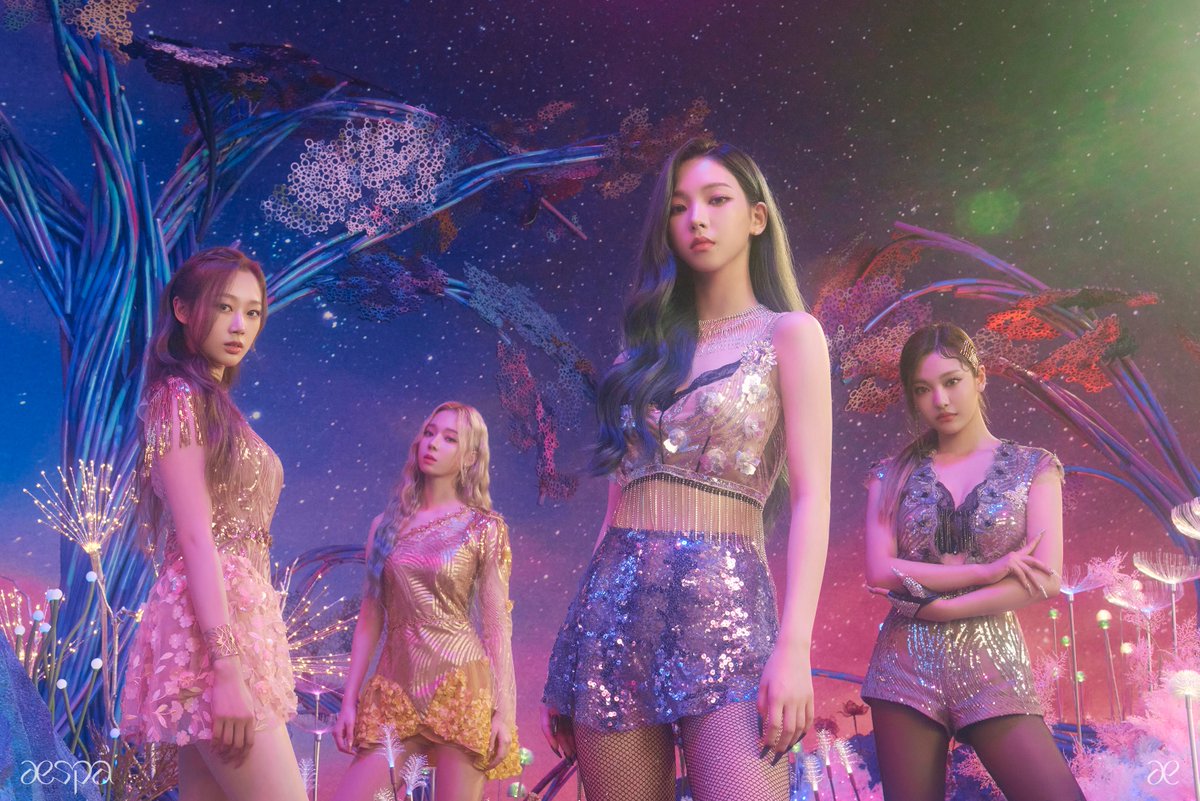
Aespa final lineup: Giselle, Winter, Karina and Ningning.
The end product is a small group, only four members, the third time in a row SM goes that route following f(x) in 2009 (five) and Red Velvet in 2014 (originally four, later five). These members are, in age order:
- Karina (Yoo Jimin). Korean. Born April 11th, 2000. The oldest member of the group and based on the teasers, the face of the group. Introduced as essentially the triple threat of the group. with "multiple talents in vocal, rap and dance". Second member to be introduced and protagonist of the "My Karina" teaser which presents the AI concept of the group. Trained for four years. She was the only trainee outside the SM Rookies system to appear in public, being part of Taemin's "Want" music video. She's the girl that appears for the first time at the 2:08 mark.
- Giselle (Uchinaga Eri). Japanese. Born October 30th, 2000. The last member to be introduced, in what happened to be her 20th birthday. Deemed to have "solid rap skills" so I assume she's the main rapper of the group. Trained the shortest period of them all, just a year. The English speaker of the group.
- Winter (Kim Minjeong). Korean. Born January 1st, 2001. First member to be introduced, considered to have "outstanding vocal and dancing skills". I assume she's the main dancer of the group. It's unclear for how long she's been a trainee but sources say at minimum three years.
- Ningning (Ning Yizhuo). Chinese. Born October 23rd, 2002. As said before, the only trainee from the "SM Rookies" team left. Youngest member and third to be introduced. In SM's words, an "outstanding voice", which leads me to believe she's the main vocalist.
Oddly, SM did not announce any of them as the visual, despite the company's legendary history at the position. It can't even be assumed it's Karina because SM has not followed a pattern when it comes to the center and the visual being the same person or two different people. For Girls' Generation (YoonA) and Red Velvet (Irene), one member assumes both roles. Meanwhile S.E.S had Eugene as the visual but Bada as the center while f(x) had Sulli as the visual and Krystal as the center.
After the lengthy introduction it's time to talk about the concept of the group. And if you asked me, Aespa symbolizes SM's essentially burying its past aesthetics where all their past girl groups resided, despite their conceptual differences, with many relatable girls (yes even those who had more intimidating faces such as Krystal and Irene) and moving towards making the NCT futuristic universe its permanent aesthetic, moving even further with the introduction of AI equivalents of the members. The AI part is definitely the biggest differentiation Aespa has over other kpop groups but also the most concerning and riskiest aspect of Aespa's concept. Yes, SM didn't invent the virtual idol concept, after all, Hatsune Miku exists since 2007, essentially meaning they once again SM picked something from japanese pop music and presented as an original idea from theirs. Even korean pop music already has a virtual girl group project to call their own, League of Legends character inspired K/DA which actually features two real world girl group members performing voice character duties. But they will be the first ones to implement it on a permanent basis and directly linking the AIs and their real world equivalents.
However, there are major concerns about Aespa's AI concept. The main one is that it could further enhance the objectification of idols. It's no secret that idols are essentially marketed as living versions of pretty dolls who need to be perfect at all costs and preserve an image of flawless boyfriends and girlfriends to fans (or in Bighit Entertainment's CEO nakedly capitalistic language, "customers"). They already look at idols as personal tamagotchis as it stands right now, with virtual avatars that can be owned, it will enhance fans possessive nature and it can be a easily exploited by groups like incels, who want exactly something like this: fictional portraits of young women who can satisfy their creepy needs. Essentially, Aespa is toeing a slim line between something innovative, trendsetting and higly techological and something insane, regressive and creepy.
Aesthetics wise, SM has come a long way from what they first envisioned from their SM Rookies back in 2015-16 and today. And to me, nothing exemplifies it better than the radical changes in outfits from the last girl left from that era in Ningning. When introduced, in 2016, just before turning 14 years old, Ningning first appeared on a plain outfit, a white school uniform with a pink apron and hair thrown to the front with forehead bangs, bare nails, very reminescent of the girlgroups of the early days of the second generation. Some may argue it was her age that drove this change, but looking at SM Rookies who were older than her such as Yiyang, Koeun and Hina the same pattern can be found, the vision SM had for their next girl group was most likely one that was focused on tradition, on looking back to the rookie years of their most legendary group Girls' Generation. The SM rookies of 2015-16 were dressed to perform the signature SNSD early hits such as "Into The New World", "Gee" and "Oh!", they were going to bring the audience back to a time where people uploaded videos on YouTube on a 4:3 aspect ratio. Aespa on the other hand couldn't be further away from that. The Ningning of 2020 has her hair thrown back, hairpins holding it, longer nails painted silver with hand acessories and a much more detailed outfit generally speaking. If she's covering any SNSD song it's probably "The Boys", "Mr. Mr." or "Catch Me If You Can"

Ningning as a member of Aespa in 2020 (left) and as part of SM Rookies in 2016 (right).
It's undeniable that k-pop has changed a lot in the four year span separating the two Ningnings, probably the most it has ever changed. On September 12th 2016, the date of her introduction, the groups that shaped the most the 3rd generation were much smaller than they were today. On the male side, BTS was just starting to breaking through, gaining popularity but far from the explosion they would enjoy after 2017. Blackpink, on the female side, were only a month old, their debut was quite popular but later that year the main girl group songs ruling the korean charts were still the standard cute songs (and so were the two biggest girl group releases of 2016). Funly enough, Aespa and Blackpink have a fair share of similarities and I would say aesthetics wise Aespa has more similarities with them than to any girl group from the "old SM", given that they have been fairly influential on shaping up new generation groups, from Everglow to Secret Number. However, the biggest one is probably how their lineup is built. Both groups have two Korean-born members (Karina and Winter, Jennie and Jisoo), a third member who is from Korean descent but foreign-born (Giselle and Rosé, which also happen to be English speakers) and a full foreign member (Ningning and Lisa). Obviously the nationality differences also tell the story about which foreign markets SM and YG targeted respectively, the foreigners of Aespa are East Asian (China and Japan), Blackpink's are Australian and Southeast Asian (Thailand). Also, it's absolutely false to call Aespa a plain copy, they are just inserted on a context where Blackpink is the main trendsetting group but at the end they are a SM group, especially the post-2016 SM. Karina may have some moments of resemblance with Jennie but she also does with Taeyeon, which despite being a product of the "old SM" is the idol they seem to look the most to replicate the success. After all Winter also has visual similarities with her and Ningning is expected to continue the elite SM. vocalist lineage that Taeyeon happens to be the main representative.
Aespa are probably under the heaviest pressure any new girl group has ever faced. They debut at a point where SM's image is taking major hits on a daily basis, with idols such as Irene and Chanyeol facing scandals. Just like Red Velvet in 2014, many see the debut of Aespa as a deflection tactic from the company to hide its scandals. Aespa can prove the doubters wrong and become a popular group, but SM is at a worst spot than compared to six years ago and that was shown on how vulnerable the group has been to rumours. Karina has been hit the hardest, with claims that she wrote text messages badmouthing every boy group with a big fandom and being a bully, which has led to massive hate against her. SM seems to trust her as the face of the project despite the allegations, since she took a central position at the group's teasers and, as shown above, essentially introduced its concept. My personal opinion is considering the timing of these controversies, carefuly crafted to hit her just as she gets close to debut, lots of it sounds like red meat to turn rabid fangirls against her from the get go and persecute her at every move. But as I said, SM has never been weaker than now and the public is currently on a bad mood with the company because of other idols wrongdoings. This defintiely affects Aespa and this definitely affects the group's ability of convincing the public who's against them now to become supportive. They will also have many challenges in regards of not making the concept too complicated or even bizarre, that has been something NCT has struggled during its career, with the unlimited members, multiple units and shuffling between them confusing even some of the most hardcore fans and limiting the group's capacity to be gain more casual listeners (which is something girl groups must have in order to survive). Right now Aespa only have the AI members and avatars as potential sources of confusion among the public and that can still lead to problems, SM better not decide to try something like keep adding new members. In case they do, they better be like After School, who didn't rock the boat much with their graduation concept once they scored a hit.
In the end SM opted to ditch the traditions that made them the main label in Korea not only for the male side with NCT and SuperM but also now with their girls in Aespa. For the former, the results have been mixed, for the latter, it remains to be seen. Historically speaking their groups have started slow and take a while to even score their first music show win, in spite of SM being the most storied record label in Korea. On the girl group side, Girls' Generation actually became the fastest to achive a win back in 2007, back when the Big 3 companies, which SM is part of, weren't as influential, thanks to their debut song becoming a sleeper hit, and it still took them 115 days, although the record has been broken six times since, with Itzy, who are very likely to be one of the main rivals for Aespa in the next generation of girl groups (if it ever takes off) now shattering it to just 9 days. Other SM groups took much longer, f(x) needed over 600 days (606) and even Red Velvet needed close to 240 (238). Now the pressure is all on Aespa's shoulders, comparisons will be inevitable and the group could either return SM back to its glory days or be a step into an irreversible many past popular labels have endured. SM debuting Aespa now gives the green light for rival labels such as YG and Bighit to start preparing their new girl groups to debut. Considering these companies have hype from past groups on their side more than SM does, by the time their groups debut Aespa has to establish itself as a top group. To make matters worse, their debut could easily be overshadowed by BTS highly anticipated comeback, which is only 3 days later.
This article closes with two videos of what SM could have gone for but passed on. A cover of "Into the New World" for animation "Shining Star". Two things are still left for Aespa: the animated characters, albeit they are not the members likenesses, just the characters of the show, and Ningning's high notes. The second is a Mickey Mouse Club performance of the original quartet of Koeun, Lami, Hina and Heri all the way back in 2015 with the question if SM should have given them a chance to be in place of Aespa. Their introduction only to never debut will forever remain one of the biggest what-ifs in the history of k-pop. Draw your conclusions.
Edit: the original version of the article had Winter as being born on december 30th, 2001. Since then it's been confirmed her date of birth is January 1st, 2001.


No comments:
Post a Comment