January 06, 2021

A 2021 girl group perspective: the most crucial year in a long time

This article is basically a continuation of the last one, where I talked about how 2020 went for girl groups. This time, we take a look on their perspectives for 2021 and discuss scenarios on how the year could end up playing out for girl groups as a whole, but first, we have to fully delimitate who are the main actors in the current girl group scene are. Essentially, we can separate the currently active girl groups in four categories:

1. The 3rd generation core: these are the groups who currently dominate the scene. They mostly debuted from 2014 to 2016. The groups I consider to be in this category are: Red Velvet, Mamamoo, Twice, Gfriend, Oh My Girl and Blackpink. The large majority of hit songs from Korean girl groups since 2016 have come from those groups. Some observations: Oh My Girl used to belong to the group below but has definitely upgraded their status after 2020. Gfriend has declined but the group's past hits mean they are part of the core of the generation. I.O.I was also here but they are long gone.

2. The 3rd generation fringes: these are groups who at this point are already past the halfway point of their careers but never fully broke through, and as the years go by, their breakout becomes less likely, even considering that Oh My Girl managed to achieve such thing in 2020. Many of them have solid fanbases (Lovelyz, Cosmic Girls), some popular girls (Cosmic Girls' Bona, April's Naeun, Momoland's Nancy and former I.O.I members such as Gugudan's Sejeong, Weki Meki's Doyeon and DIA's Chaeyeon),  but that popularity never fully transfered to their groups and that also meant that even their most popular members are less known than most members of the core groups. Groups who belong here include Lovelyz, April, CLC, DIA, Cosmic Girls, Weki Meki, Momoland (who had a huge hit but didn't take the full step up the ladder) and Gugudan (at least before they disappeared).

3. The class of 2018: A transition year, hence the fact many are undecided if these groups are from the 3rd generation or from the 4th. The top groups of this class (Iz*one and (G)I-DLE) have been more successful than those from the fringe of the 3rd generation but have never reached the heights of the core groups and still haven't scored hits as big as theirs. Meanwhile groups such as Loona and fromis_9 are a step below the 3rd generation fringes, they aren't full "nugus" but they have less recognizeable members than these groups. A problem lies ahead for this class: Iz*one is a temporary group and is set to disband in the first few months of 2021.

4. The rookies: groups who debuted in 2019 and 2020. So far these classes have been quite weak. Itzy is the only group here whose members have any sort of public recognition, but their peak so far happened at debut. Aespa, the other group here who comes from a big label, just debuted a month ago, so it's too early to tell. They will have the push from SM so their members will get some recognition, but so far they are way below their main rivals Itzy. Besides them, most groups here are in the best case charting like the fringes of the 3rd generation (StayC) or in the worst case are nobodies in Korea carried by an overseas fanbase (Secret Number). Stationed in between sit groups such as Rocket Punch, Everglow, Cherry Bullet and Weeekly, with small local fanbases.

PS: second generation groups are irrelevant for this analysis. The only 2nd generation group that remains truly active is Apink (who are on a contract year for 2021), everybody else either disbanded, is on an indefinite hiatus that is essentially the same thing as a disbandment or in the best case is semi-active. If, let's say, a Girls' Generation reunion happens in 2021, it'll be a self-contained event that will bear no impact for other groups besides them. Just like when S.E.S reunited in 2016.

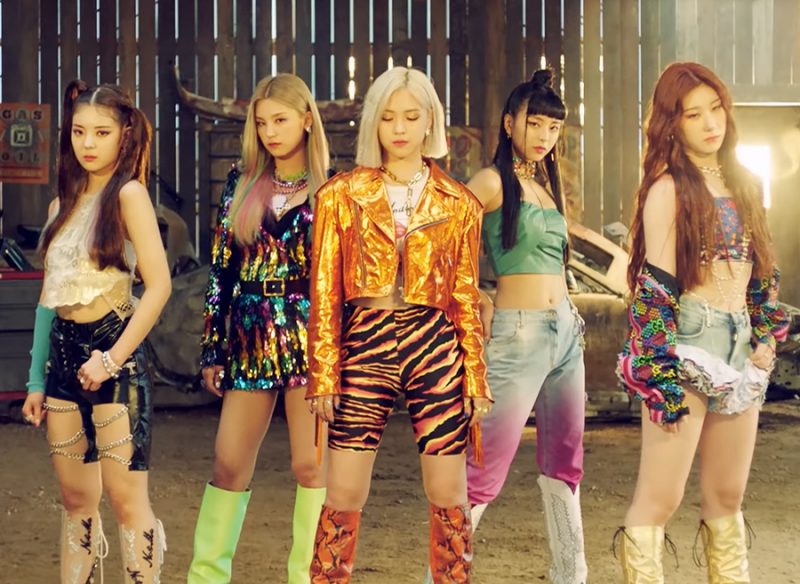
Itzy in the "Not Shy" music video. From left to right: Lia, Yeji, Ryujin, Yuna and Chaeryeong

With that being said now we can start drawing the scenarios for how 2021 could go for girl groups. I came up with five different scenarios of what could happen next year and, in my personal opinion, how likely to happen each one of them is.

Scenario 1: new guard challenges old guard

In this scenario, the veteran groups, particularly the 3rd generation core, have a quite strong year, leading the 4th generation into a scenario where they have to fight for the public's attention with established names. And they manage to succeed and demarcate territory in spite of such competition.  Groups such as (G)I-DLE and Itzy essentially start charting on pair with the past generation's core, while newcomers such as Aespa and StayC start to become known to the public. Iz*one's disbandment ends not being a setback for the generation, just like I.O.I's wasn't for the 3rd. This scenario is very unlikely to happen, as both the rise of the 2nd and 3rd generations was marked by a vacuum left by the previous one. Historically speaking clashing against veteran groups is bad for new groups. Veterans have a set core fanbase, the public's attention and popular members. New groups obviously have to create the conditions to have such advantages. The most likely way for the new generation to rise comes from our follow-up scenario.

Scenario 2: 2016 redux, a passing of the torch

In this scenario, we essentially have peaceful transition between generations. That has actually been the case in the past. The 2nd generation started thanks to an interregnum period, where 1st generation groups mostly disbanded but it took a few years until new ones arrived. For the 3rd generation, they didn't have such luxury, as there were still popular and active 2nd generation groups when they broke through. However, many of those groups took hiatuses to focus on solo activities, or had less successful comebacks, with only a few still managing to do well. That leads us to 2016, which was the breakout year for the 3rd generation. On that year, girl groups were very strong, scoring a total of 10 number one hits, the most since 2011. However, the breakdown of those hits was quite different from past years, with 8 of them coming from groups who had debuted since 2014 and only 2 from groups who debuted before 2014. That's despite the fact that none of those young groups managing to score a #1 hit on the previous year. Matter of fact, some of them hadn't even debuted. It was a total landscape change.

This was possible because the 2nd generation groups, as said above, retreated from their position of dominance in the scene. Girls' Generation, Miss A and Girl's Day took hiatuses. 2NE1, 4Minute and Kara outright disbanded. Apink, AOA and Exid had only one comeback, which weren't as successful as their previous ones. The only ones who managed to hit big were Sistar and Wonder Girls, who essentially acted as the bridge between generations, scoring hits on the summer of 2016 that blended with the ones from the newcomers. It's impossible to predict which groups are going to play each role if 2021 ends up being the year where this scenario materializes. What's factual is that the 4th generation needs a year like this to rise to the top. The question is when this year is going to come. In fact, not even when, it's worth asking if it's ever going to come. If it doesn't, then the scenarios below come into play.
2016 had the rise of new girl groups such as Twice (top) while older ones such as the Wonder Girls (bottom left) and Sistar (bottom right) still had hits, leading to a smooth generational transition.

Scenario 3: a timid transition

In this scenario, the groups from the class of 2018 and beyond start to occupy more space in the scene, but fail from reach the heights of past generation groups. In common with scenario 2 is the fact that many past generation groups leave the scene. This vaccum allows 4th generation groups to be more relevant, but instead of scoring #1 hits they essentially follow this hierarchy: the core of the generation becomes the ones who manage to chart in the top 10, with the best case scenario being a top 5 hit ocasionally. Meanwhile, the groups that settle along the fringes managed to chart around the top 100. Itzy and (G)I-DLE are the best equiped groups to be part of the core of the generation if that's the case (Iz*one too if they weren't set to disband). Aespa could join them if the resources SM is most likely going to spend on them to make them more popular end up producing results. New girl groups from big companies such as Big Hit and YG, if they indeed debut in 2021, also could be part of that core. However, even for big companies, having popular old groups doesn't automatically translates into success for new ones (for medium to small companies it pretty much never translates). Meanwhile, at the fringes, groups such as StayC, Loona and fromis_9 would lead the way, with them also seeing improvements on their charting, hovering around the top 100 to top 200. A wild card, in case it debuts, would be Starship Entertainment's new girl group, which could go either way, given Starship is a mid-sized company, but unless something goes wrong, it will feature the most popular female idol of the new generation: current Iz*one member Jang Wonyoung, who is under contract with Starship. As said above, this scenario can only take place with some 3rd generation retreatment, but what if it doesn't happen? That leads us to the next one.
Audition poster to recruit female trainees to Big Hit Entertainment's new girl group. Accoring to the company, it's going to debut in 2021 and will be co-managed with Source Music, Gfriend's company and now a sublabel of Big Hit.

Scenario 4: overshadowed

This essentially the status quo scenario. Currently, the biggest difficulty for 4th generation groups, is the fact that 3rd generation groups still largely overshadow them. They have the fans, the public, the media's attention and even their least successful comebacks still perform barely worse than the best charting comebacks from 4th generation groups. Essentially, that means 2021 will be more of the same. There will be some internal shuffling between the generations, with some old groups having better years than others, some disbanding, while some new generation groups will do better compared to 2020, others worse, but the results will be fairly static. That has been the case since 2018, with the girl group scene being quite static to a point that even the most successful new girl groups still slot themselves behind the veterans who debuted in the 2014-16 window. For 2020, many pegged (G)I-DLE or Iz*one to have their first smash hit, or Itzy to match the heights of their debut. Instead, it was Oh My Girl, a five-year old group riding the winds of a successful stint at a competition show (of which (G)I-DLE took part on) who did what people were expecting from the new groups. If even once mid-tier 3rd generation groups can make that jump before the 4th generation groups do, it bears the question: can these groups even take over the scene at all? That leads us to the final scenario of this video. And it's a quite gloomy one.

Scenario 5: girl group irrelevance

Dating back to at least 1997, girl groups have been a staple of the Korean pop music scene. Therefore, they can't suddenly disappear, right? Unfortunatly, the answer is no and something similar to this scenario already happened once. In the 1st generation, the 3 main girl groups were S.E.S, Fin K.L and Baby V.O.X. From 1997 to until around 2002. In December of the year, S.E.S was the first one to leave, as they announced their disbandment. Fin K.L were the second, as they started their hiatus, which was only interrupted briefly by a 2005 release that essentially acted as their goodbye song. Baby V.O.X stayed for longer, but the last true relevant year of the group was in 2003. The group released one more album in 2004, went on hiatus and disbanded in 2006. On the background of this trio, new groups started to debut. However, basically none of them managed to take off (the sole exception being 2001 debutants Jewelry) so the scene started to get emptier each year. That was a temporary situation, since the then dormant girl group scene witnessed a ressurgence in 2007, with the debut of groups such as Girls' Generation, Wonder Girls and Kara, but one that happened nonetheless, with the mid-2000s essentially being a period completely devoided of successful girl groups in Korea.

Why am I bringing this? Because the current situation is probably the one where girl groups have reached the closest to this point. As said in scenario 4, the currently status is that 3rd generation groups have largely overshadowed 4th generation ones. Another big problem is the fact that the Korean public is paying less attention to new groups year after year. As the old groups start to leave the scene, the new ones might not manage to rise, and instead start to chart worse as the public interest on them wanes alongside the departure of the old ones. There is no generational transfer of fans, no new fans joining the fold and a the public fully pulls the plug on them. And if new girl groups don't start to rise to the top in 2021, there is going to be a point where they are no longer new, and once you get past your first 3 years, it is hard for a group to rise beyond their popularity levels at that specific point. 

Therefore this makes 2021 the most important year for girl groups in Korea in a long time, at least since 2016, which is the year that, as said previously, brought the rise of the 3rd generation. 2021 better be the one that brings the rise of the 4th, otherwise time will start to run out for them.
January 04, 2021

Elkie and the poor treatment of chinese idols (and foreigners in general)

On December 26th, 2020, a surprising announcement arrived at the world of Korean pop music. As most were on a post-Christmas mood, CLC Chinese member Elkie came over with bombastic news that she decided to sue her agency, Cube Entertainment, on the grounds of not fulfilling payments. Many have suspected this relates to her participation on the drama "The Rich Son" in 2018. However, to fully understand her story, we need to go back a few years.

The year is 2016. Cube Entertainment's new girl group, CLC, had debuted less than a year ago but were already undergoing some changes. The group debuted in March 2015 and was originally a quintet for its first three releases, "Pepe", their debut single, part of their debut extended play "First Love", follow-up standalone single "Eighteen", a synth pop track whose lyrics are about a teenage girl expressing her love to an older man, and finally, "Curious (Like)", for their second extended play, "Question". However, none of them managed to hit, with Pepe being their highest peak at #143 on the Gaon digital chart. That was particularly surprising considering Cube's past record, which included many successful artists such as HyunA, Beast, G.NABTOB, Apink (as part of their A Cube sublabel) and CLC's own predecessors 4Minute. Cube was clearly unsatisfied with the group, to a point that in spite of the three said releases coming in a two-month span, CLC wouldn't be seen again until February 2016, with two new members on their lineup: Kwon Eunbin and Chong Ting-Yan, also known as Elkie.

It was a quite messy change to the group dynamics. Member Seunghee, who was CLC's original leader, resigned from her spot, with Seungyeon being named the new leader. Member Yeeun, originally the youngest of the group (which is quite an advantage in Korean idol groups) was suddenly relegated to 3rd youngest, as both Elkie and Eunbin were younger than her, a similar process to the one that happened to Red Velvet in 2015, which added Yeri to the group, making her the youngest member over the original one in Joy. There was also another problem, with the delays on their comeback, Eunbin was already slated to represent Cube on the new competition show "Produce 101", alongside Jeon Soyeon (yes, the current leader of (G)I-DLE), so when she was announced a new CLC member, she was already taking part at the show, with Cube stating that she would join CLC promotions for their upcoming single, "High Heels" in case she was eliminated from "Produce 101". In the end, she did not join the promotions, with the group performing as 6 and many blamed her slide on the "Produce 101" rankings, as she initially ranked in the top 10 for the first couple rounds but finished 32nd, eliminated one episode before the finale, on the announcement from Cube that she would be joining the group. In spite of all these shuffling, "High Heels" remains to this day the most successful CLC song on Korean charts, peaking at #120 at the Gaon digital charts, suggesting that the new lineup gave a small albeit brief boost to the group.
CLC posing for teasers of "High Heels", their first comeback as a 7-member group. Elkie pictured 3rd from the left (the one with the red beret and suspenders)

In the same 2016 that added Elkie to CLC, foreign idols were enjoying a resurgence in popularity among both Korean entertainment companies and the public in general. Gone were the fears of lawsuits such as the ones where three of Exo's chinese members departed the group, as companies started to debut foreign idols en masse. In the previous year, Pledis Entertainment had already debuted boy band Seventeen, featuring two chinese members, Jun and The8. JYP Entertainment debuted Twice, featuring four foreigners out of nine members, three Japanese, Momo, Mina and Sana, and a Chinese in Tzuyu (who happens to be a big friend of Elkie). Then in 2016 the group saw a meteoric rise, with its foreigners role playing a major role, as Sana went viral and Tzuyu rose to most popular member status in Korea, which is rare for a foreigner, propped by her youthful visuals. As the year progressed, many more groups debuted with a lineup featuring foreign members. First it was Cosmic Girls, featuring three Chinese members: Cheng Xiao, Xuanyi and Meiqi. Xiao, just like Tzuyu, also managed to be the most popular member, going viral for her otherworldly flexibility. In the final results of "Produce 101", Chinese idol Zhou Jieqiong, also known as Kyulkyung, finished in 6th place, earning a spot on I.O.I, the group formed from the competition show. YG Entertainment's Blackpink debuted featuring Thai member Lisa. CLC labelmates Pentagon also debuted in 2016 with one Japanese (Yuto) and one Chinese (Yan An) on their lineup. Matter of fact, Elkie herself wasn't even the first foreign member of CLC, as they had Sorn, who is Thai, on their lineup since debut.

However, on the geopolitical arena, something started to change that ended up halting such favorable situation for foreign idols, particularly those from China: the development of the Terminal High Altitude Arena Defense (THAAD), an anti-missile system, agreed in July of 2016 between military officials of Korea and the United States. China deemed the development of the system as a threat to its national security, slapping sanctions on many Korean imports, including entertainment-related ones. This had a major impact on such companies, which saw their combined balance of payment surplus cut in half, going from $520 million in 2016 to $270 million in 2017, after China shut them the door. Lotte Group, the Korean multinational who rented its land to be used for THAAD activites, suffered major boycotts in China. 

Meanwhile, on the idol front, the increased tensions between the two countries were the final straw for many Chinese idols to depart Korea for good. The two who highlight this trend the best, which would become commonplace in the following years, come from Korea's biggest label, SM Entertainment: Lay Zhang, from boy band Exo, and Victoria Song, from girl group f(x). In 2015, SM opened individual studios in China for both, as Lay got his in April and Victoria hers in October. The studios were a reaction from SM following the previously mentioned Exo lawsuit, which left Lay as the sole Chinese member of the group, allowing their Chinese idols still under contract to have more control of their solo activities in chinese soil while also getting a share of their earnings in China. Later some labels would repeat the strategy, such as JYP Entertainment with Chinese GOT7 member Jackson Wang. Lay had already been focused on solo activities in China since 2014, but in 2016 finally decided to debut as a soloist, with the album "Lose Control" and has become one of the top entertainers in China since. His last participation on an Exo release was in December of that year, for their winter album "For Life" with a brief cameo for the Chinese version of "Tempo" in 2018. Victoria did not miss many f(x) activities, as the group's hibernation into an indefinite hiatus coincided with her departure, albeit she was absent from what was probably the group's last concert, and has since established a successful career as an actress and soloist in China. They wouldn't leave without a final controversy, as they were two of many Chinese idols who opposed a court ruling regarding China's territorial claims in the South China Sea, alongside Miss A members Fei and Jia, Fiestar's Cao Lu and Super Junior-M Zhou Mi.
f(x) member Victoria (Song Qian) and Exo member Lay (Zhang Yixing) attending an event in 2015. Albeit still officially members of their respective groups, both Chinese idols haven't promoted with them since 2016, as the relations between China and Korea have worsened.

Although the labeling of departing Chinese idols as traitors was not something new, hence the fact that many label the three former Exo Chinese members who filed lawsuits against SM Entertainment as "traitor line", it started skyrocketing since then. The dynamic has also affected other foreign idols such as those from Japan and Thailand, with eventual slips from idols of such countries gaining attention as if they were akin to diplomatic incidents, with the increasing xenophobia inside the Korean society wiping out most of the support towards foreign idols, with Chinese idols taking the worst of it, to a point that the "traitor" narrative has even been applied to newly debuted idols such as Aespa's Ningning. In 2020, COVID-19 added an extra layer to the witch hunt towards them, as the narrative in Korea about the virus is similar to the one peddled in much of Western media, treating the coronavirus as a "Chinese virus". As a result, any news regarding China and its people in Korea gets strong reactions from local netizens. As an example, look no further than the petition to ban Chinese idols from working in Korea, citing once again the likes of Victoria, Cheng Xiao, Kyulkyung and Lay, many of them who used to be popular on a not so distant past in the country, as shown above. Even idols from places in China Koreans are sympathetic to such as Taiwan and Hong Kong, are not getting good reactions. Tzuyu, the once popular Taiwanese visual from Twice, has slid from 3rd most popular idol in the country in 2016, to 9th in 2017, to 12th in 2018 to out of the top 20 in 2019, that was despite the fact that her group had an increase in popularity during most of those years. Elkie, who is from Hong Kong, also got many accusations of being a liar over her lack of payments and another Chinese idol seeking to break her contract just so she can return home, with many bringing the example of Lai Guanlin, former Wanna One member and also under Cube Entertainment, who sought to break the contract with the company in 2019 but ultimately lost.  

It must be said that, if Elkie indeed wants to and ultimately decides to return to China, that's an entirely comprehensible decision and actually the most rational one. The odds of a foreign idol debuting these days only to become a filler member that many inside the fan base ignore or despise (particularly among Korean fans) get higher each day. And if you are a Chinese idol trying to leave filler member life, there is no better inspiration than Meng Meiqi. As previously mentioned, Meiqi debuted in Korea as a member of Cosmic Girls in 2016. There is a simple rule: the bigger the group, the higher the odds of being a filler member. In a 12 (later 13) member group, that means you have to be quite lucky not to be one. Meiqi wasn't. Koreans picked a Chinese member to pay attention to, but it was Cheng Xiao, as said before. During her stint on Cosmic Girls, it can be easily argued Meiqi was the least popular member. If being under such position is already upsetting under a four-member group, imagine how bad it must be when you're dead last among 13 people. 

However, being a "traitor" ended up as Meiqi's best career move. In April 2018 she joined, alongside her Cosmic Girls group mate Wu Xuanyi, the chinese version of "Produce 101", which coincidentally had a mentor who in the past left a Korean group to return to China: former Exo member Huang Zitao. Speaking of mentors, their other Chinese group mate, Cheng Xiao, had joined, three months earlier, a similar show, "Idol Producer", where she played such role alongside other big chinese idols such as Lay, Kyulkyung and Jackson, while Meiqi and Xuanyi were joining their show as contestants, highlighting how the abyss in popularity between Xiao and her fellow countrywomen was just as big in China as it was in Korea. But that wouldn't last for long. The duo quickly dominated the competition, with Xuanyi taking the lead at episode 3. After episode 5, though, it was Meiqi's show. She took the lead and never looked back, finishing first with a whopping 185.2 million votes, with Xuanyi coming in 2nd at 181.5 million. The win made Meiqi the center of the show's debuting group, "Rocket Girls 101". She blossomed as an idol during her time in the group, with her dancing abilities drawing special attention. Her solo debut extended play sold 1 million copies in 20 minutes, to this day, it has sold over 2.3 million copies. She later extended the record, as her 2nd EP sold 1.43 million copies in just 8 minutes. She essentially went from a nondescript member of Cosmic Girls to the biggest female idol in China. To this day, it has sold 1.78 million copies.

Meng Meiqi performing at "Rave Now". February 1st, 2019. Once one of the least popular members from Cosmic Girls, she has become a big star since returning to China, breaking many sales records.

And no, contrary to what some may be thinking, Meiqi is not an exception, just the most successful example alongside Lay. Sally (Liu Xiening), from now-disbanded group Gugudan was a non-factor when she was part of it, but now she has returned to China, placed 6th on reality show "Produce Camp 2020" and debuted for their new group, "Bonbon Girls 303".. Old, more established famous idols aren't doing too bad year. The already mentioned Victoria Song, who was a mentor on the same show Sally took part of, and was mentioned by the contestant as a role model, released her solo album this year and became the fastest Chinese female artist to get a diamond certification. Meanwhile, in Korea, popular Chinese idols have largely disappeared. The few exceptions are (G)I-DLE member and Elkie's labelmate Yuqi and Everglow member and Meiqi's labelmate Yiren, who are both the most popular members of their respective groups, as both of them have bet on their variety personas to get around the unfriendly situation to Chinese idols in Korea. But for every Yuqi and Yiren there are 10 Elkies, and being stuck in a situation where you act in a drama, but don't get paid, you debut solo but no one gives you attention, especially on a group that has been doomed from the start like CLC, is not something you want to endure. May she find success elsewhere, far away from Cube's mismanagement.

Brave Girls' unusual backstory and their future prospects

20 days ago, Brave Girls seemed like your typical aging idol group with no future to look forward to. The fact that they even released a son...