This article is basically a continuation of the last one, where I talked about how 2020 went for girl groups. This time, we take a look on their perspectives for 2021 and discuss scenarios on how the year could end up playing out for girl groups as a whole, but first, we have to fully delimitate who are the main actors in the current girl group scene are. Essentially, we can separate the currently active girl groups in four categories:
1. The 3rd generation core: these are the groups who currently dominate the scene. They mostly debuted from 2014 to 2016. The groups I consider to be in this category are: Red Velvet, Mamamoo, Twice, Gfriend, Oh My Girl and Blackpink. The large majority of hit songs from Korean girl groups since 2016 have come from those groups. Some observations: Oh My Girl used to belong to the group below but has definitely upgraded their status after 2020. Gfriend has declined but the group's past hits mean they are part of the core of the generation. I.O.I was also here but they are long gone.
2. The 3rd generation fringes: these are groups who at this point are already past the halfway point of their careers but never fully broke through, and as the years go by, their breakout becomes less likely, even considering that Oh My Girl managed to achieve such thing in 2020. Many of them have solid fanbases (Lovelyz, Cosmic Girls), some popular girls (Cosmic Girls' Bona, April's Naeun, Momoland's Nancy and former I.O.I members such as Gugudan's Sejeong, Weki Meki's Doyeon and DIA's Chaeyeon), but that popularity never fully transfered to their groups and that also meant that even their most popular members are less known than most members of the core groups. Groups who belong here include Lovelyz, April, CLC, DIA, Cosmic Girls, Weki Meki, Momoland (who had a huge hit but didn't take the full step up the ladder) and Gugudan (at least before they disappeared).
3. The class of 2018: A transition year, hence the fact many are undecided if these groups are from the 3rd generation or from the 4th. The top groups of this class (Iz*one and (G)I-DLE) have been more successful than those from the fringe of the 3rd generation but have never reached the heights of the core groups and still haven't scored hits as big as theirs. Meanwhile groups such as Loona and fromis_9 are a step below the 3rd generation fringes, they aren't full "nugus" but they have less recognizeable members than these groups. A problem lies ahead for this class: Iz*one is a temporary group and is set to disband in the first few months of 2021.
4. The rookies: groups who debuted in 2019 and 2020. So far these classes have been quite weak. Itzy is the only group here whose members have any sort of public recognition, but their peak so far happened at debut. Aespa, the other group here who comes from a big label, just debuted a month ago, so it's too early to tell. They will have the push from SM so their members will get some recognition, but so far they are way below their main rivals Itzy. Besides them, most groups here are in the best case charting like the fringes of the 3rd generation (StayC) or in the worst case are nobodies in Korea carried by an overseas fanbase (Secret Number). Stationed in between sit groups such as Rocket Punch, Everglow, Cherry Bullet and Weeekly, with small local fanbases.
PS: second generation groups are irrelevant for this analysis. The only 2nd generation group that remains truly active is Apink (who are on a contract year for 2021), everybody else either disbanded, is on an indefinite hiatus that is essentially the same thing as a disbandment or in the best case is semi-active. If, let's say, a Girls' Generation reunion happens in 2021, it'll be a self-contained event that will bear no impact for other groups besides them. Just like when S.E.S reunited in 2016.
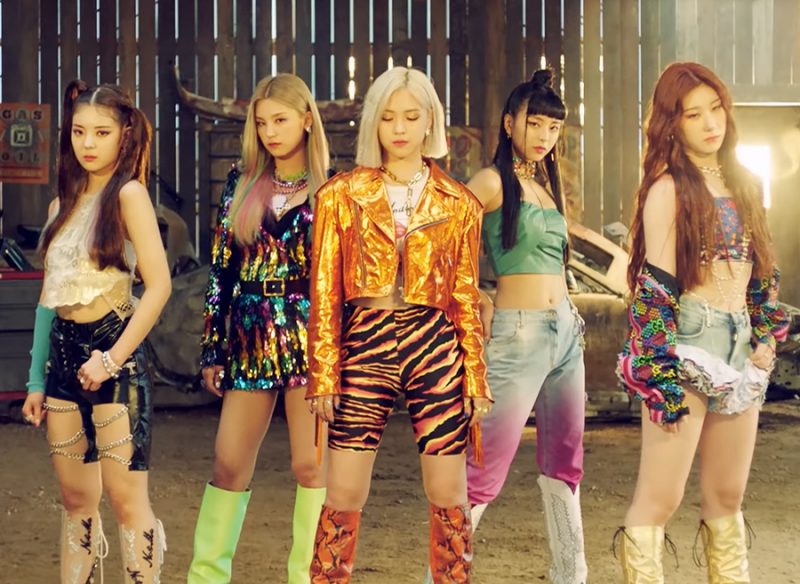
Itzy in the "Not Shy" music video. From left to right: Lia, Yeji, Ryujin, Yuna and Chaeryeong
With that being said now we can start drawing the scenarios for how 2021 could go for girl groups. I came up with five different scenarios of what could happen next year and, in my personal opinion, how likely to happen each one of them is.
Scenario 1: new guard challenges old guard
In this scenario, the veteran groups, particularly the 3rd generation core, have a quite strong year, leading the 4th generation into a scenario where they have to fight for the public's attention with established names. And they manage to succeed and demarcate territory in spite of such competition. Groups such as (G)I-DLE and Itzy essentially start charting on pair with the past generation's core, while newcomers such as Aespa and StayC start to become known to the public. Iz*one's disbandment ends not being a setback for the generation, just like I.O.I's wasn't for the 3rd. This scenario is very unlikely to happen, as both the rise of the 2nd and 3rd generations was marked by a vacuum left by the previous one. Historically speaking clashing against veteran groups is bad for new groups. Veterans have a set core fanbase, the public's attention and popular members. New groups obviously have to create the conditions to have such advantages. The most likely way for the new generation to rise comes from our follow-up scenario.
Scenario 2: 2016 redux, a passing of the torch
In this scenario, we essentially have peaceful transition between generations. That has actually been the case in the past. The 2nd generation started thanks to an interregnum period, where 1st generation groups mostly disbanded but it took a few years until new ones arrived. For the 3rd generation, they didn't have such luxury, as there were still popular and active 2nd generation groups when they broke through. However, many of those groups took hiatuses to focus on solo activities, or had less successful comebacks, with only a few still managing to do well. That leads us to 2016, which was the breakout year for the 3rd generation. On that year, girl groups were very strong, scoring a total of 10 number one hits, the most since 2011. However, the breakdown of those hits was quite different from past years, with 8 of them coming from groups who had debuted since 2014 and only 2 from groups who debuted before 2014. That's despite the fact that none of those young groups managing to score a #1 hit on the previous year. Matter of fact, some of them hadn't even debuted. It was a total landscape change.
This was possible because the 2nd generation groups, as said above, retreated from their position of dominance in the scene. Girls' Generation, Miss A and Girl's Day took hiatuses. 2NE1, 4Minute and Kara outright disbanded. Apink, AOA and Exid had only one comeback, which weren't as successful as their previous ones. The only ones who managed to hit big were Sistar and Wonder Girls, who essentially acted as the bridge between generations, scoring hits on the summer of 2016 that blended with the ones from the newcomers. It's impossible to predict which groups are going to play each role if 2021 ends up being the year where this scenario materializes. What's factual is that the 4th generation needs a year like this to rise to the top. The question is when this year is going to come. In fact, not even when, it's worth asking if it's ever going to come. If it doesn't, then the scenarios below come into play.

2016 had the rise of new girl groups such as Twice (top) while older ones such as the Wonder Girls (bottom left) and Sistar (bottom right) still had hits, leading to a smooth generational transition.
Scenario 3: a timid transition
In this scenario, the groups from the class of 2018 and beyond start to occupy more space in the scene, but fail from reach the heights of past generation groups. In common with scenario 2 is the fact that many past generation groups leave the scene. This vaccum allows 4th generation groups to be more relevant, but instead of scoring #1 hits they essentially follow this hierarchy: the core of the generation becomes the ones who manage to chart in the top 10, with the best case scenario being a top 5 hit ocasionally. Meanwhile, the groups that settle along the fringes managed to chart around the top 100. Itzy and (G)I-DLE are the best equiped groups to be part of the core of the generation if that's the case (Iz*one too if they weren't set to disband). Aespa could join them if the resources SM is most likely going to spend on them to make them more popular end up producing results. New girl groups from big companies such as Big Hit and YG, if they indeed debut in 2021, also could be part of that core. However, even for big companies, having popular old groups doesn't automatically translates into success for new ones (for medium to small companies it pretty much never translates). Meanwhile, at the fringes, groups such as StayC, Loona and fromis_9 would lead the way, with them also seeing improvements on their charting, hovering around the top 100 to top 200. A wild card, in case it debuts, would be Starship Entertainment's new girl group, which could go either way, given Starship is a mid-sized company, but unless something goes wrong, it will feature the most popular female idol of the new generation: current Iz*one member Jang Wonyoung, who is under contract with Starship. As said above, this scenario can only take place with some 3rd generation retreatment, but what if it doesn't happen? That leads us to the next one.

Audition poster to recruit female trainees to Big Hit Entertainment's new girl group. Accoring to the company, it's going to debut in 2021 and will be co-managed with Source Music, Gfriend's company and now a sublabel of Big Hit.
Scenario 4: overshadowed
This essentially the status quo scenario. Currently, the biggest difficulty for 4th generation groups, is the fact that 3rd generation groups still largely overshadow them. They have the fans, the public, the media's attention and even their least successful comebacks still perform barely worse than the best charting comebacks from 4th generation groups. Essentially, that means 2021 will be more of the same. There will be some internal shuffling between the generations, with some old groups having better years than others, some disbanding, while some new generation groups will do better compared to 2020, others worse, but the results will be fairly static. That has been the case since 2018, with the girl group scene being quite static to a point that even the most successful new girl groups still slot themselves behind the veterans who debuted in the 2014-16 window. For 2020, many pegged (G)I-DLE or Iz*one to have their first smash hit, or Itzy to match the heights of their debut. Instead, it was Oh My Girl, a five-year old group riding the winds of a successful stint at a competition show (of which (G)I-DLE took part on) who did what people were expecting from the new groups. If even once mid-tier 3rd generation groups can make that jump before the 4th generation groups do, it bears the question: can these groups even take over the scene at all? That leads us to the final scenario of this video. And it's a quite gloomy one.
Scenario 5: girl group irrelevance
Dating back to at least 1997, girl groups have been a staple of the Korean pop music scene. Therefore, they can't suddenly disappear, right? Unfortunatly, the answer is no and something similar to this scenario already happened once. In the 1st generation, the 3 main girl groups were S.E.S, Fin K.L and Baby V.O.X. From 1997 to until around 2002. In December of the year, S.E.S was the first one to leave, as they announced their disbandment. Fin K.L were the second, as they started their hiatus, which was only interrupted briefly by a 2005 release that essentially acted as their goodbye song. Baby V.O.X stayed for longer, but the last true relevant year of the group was in 2003. The group released one more album in 2004, went on hiatus and disbanded in 2006. On the background of this trio, new groups started to debut. However, basically none of them managed to take off (the sole exception being 2001 debutants Jewelry) so the scene started to get emptier each year. That was a temporary situation, since the then dormant girl group scene witnessed a ressurgence in 2007, with the debut of groups such as Girls' Generation, Wonder Girls and Kara, but one that happened nonetheless, with the mid-2000s essentially being a period completely devoided of successful girl groups in Korea.
Why am I bringing this? Because the current situation is probably the one where girl groups have reached the closest to this point. As said in scenario 4, the currently status is that 3rd generation groups have largely overshadowed 4th generation ones. Another big problem is the fact that the Korean public is paying less attention to new groups year after year. As the old groups start to leave the scene, the new ones might not manage to rise, and instead start to chart worse as the public interest on them wanes alongside the departure of the old ones. There is no generational transfer of fans, no new fans joining the fold and a the public fully pulls the plug on them. And if new girl groups don't start to rise to the top in 2021, there is going to be a point where they are no longer new, and once you get past your first 3 years, it is hard for a group to rise beyond their popularity levels at that specific point.
Therefore this makes 2021 the most important year for girl groups in Korea in a long time, at least since 2016, which is the year that, as said previously, brought the rise of the 3rd generation. 2021 better be the one that brings the rise of the 4th, otherwise time will start to run out for them.


No comments:
Post a Comment