November 24, 2020

BTS, Flamengo and the politics of entertainment

In 2019, Clube de Regatas do Flamengo, Brazil's most popular football club, had a banner year. Under the guidance of Portuguese manager Jorge Jesus, the team shattered records and trounced the competition, winning the brazilian league on a record 90 points. It also won the Copa Libertadores, South America's most important club football tournament, for the first time since 1981, beating Argentinian side River Plate in dramatic fashion for a come from behind win. With that feat it also became the first Brazilian team since Santos in 1963 to win both the domestic league and the Copa Libertadores in the same year. Flamengo was so successful under Jesus' one year tenure as its head coach that the team won more titles (five) than it had defeats (four). Following an intense 4-4 draw against Vasco da Gama, Flamengo's main rival, that featured two lead changes and a stoppage game goal that just prevented the team from winning yet another game, forward Bruno Henrique came up with a statement that went viral among fans to describe the team's dominance, claiming Flamengo was "on a whole different league" (Portuguese: "em outro patamar"), highlighting the gap between the two rivals, given that Vasco da Gama fans were celebrating simply the fact that their team had not lost that game, considering how unstoppable Flamengo was at that time.

Such massive success led to a just as massive greed and attempts to capitalize on it for profits and political gains. As the team's historical run went on, Flamengo's board of directors got increasingly closer to the administration of far-right brazilian president Jair Bolsonaro. The president and other government officials were spotted attending Flamengo games wearing the team's jersey. Government officials were given honorary titles by the club. When Brazilian football was suspended following the escalation of the COVID-19 pandemic, Flamengo was the one lobbying the most for the games to restart. But nothing exemplifies the almost symbiotic relationship between Flamengo and the Brazilian government than "Provisional Mesure 984". In Brazilian law, a provisional measure is an emergency presidential decree that instantly becomes a law, but only for a period of 60 days (renewable for an extra 60). During that time, it must be appreciated by Congress and takes priority over other bills. If Congress doesn't approve it before its expiration, it's automatically revoked. This bill, which changed the way broadcasting rights were sold in brazilian football, was drafted with the massive help of Flamengo's president, Rodolfo Landim, to a point it was dubbed "Flamengo's Provional Measure". It would massively increase the bargain power of the most popular clubs to negotiate broadcasting rights, in detriment of smaller clubs, whose games have less demand. Considering the fact Flamengo is the club with the most fans in Brazil, it would massively increase their gap in money earned from broadcasting rights compared to other clubs, essentially allowing the team to monopolize brazilian football. The bill ultimately died in Brazil's Congress, but not before becoming the poster child of how Flamengo turned itself into the "government's official team". Worse, a far-right government, despite the team's fan base largely coming from a working class background and always being proud of such origins, to a point many fans have distanced themselves from the club.

Two paragraphs in and after such long introduction, you the reader may be asking: what does a Brazilian football team have anything to do with the world of Korean pop music? The answer is quite simple. There is a record label that's doing exactly the same, riding an immense wave of success and achievements to push government officials to give them exactly what they wanted and monopolize the field they are part of. That company is none other than Big Hit Entertainment, home of BTS, the biggest current phenomenon in the Korean pop music scene. 

Flamengo directors meet Brazilian president Jair Bolsonaro (2nd from the left, wearing a club jersey), including club president Rodolfo Landim (3rd from the left). May 19th, 2020.

On November 20th, which happened to be the same day BTS released its most recent album, "Be", the Defense Committee of Korea's National Assembly approved a bill to change the country's laws regarding military enlistment, which amends the country's Military Service Act with a provision that allows for "exceptional artists in pop culture, who helped elevate South Korea's reputation around the world, the right to defer their military duties until the age of 30". According to current enlistment laws, every physically able korean men must enlist in the military at any time between 18 and 28 years of age, and serve in the military for somewhere between 18 and 24 months. The law came in force as a consequence of the Korean War of 1950-53, which separated the Korean peninsula into two countries, one communist in the North and one capitalist in the South. Technically, the conflict never had a formal ending, as the South refused to sign the armistice, meaning the two countries remain at war to this day, with large active military contingents, as a consequence Korea is one of the few places that still has ongoing conscription.

Very few people manage to get an exemption from mandatory enlistment. For athletes, the person must either win an Olympic medal of any type or win a gold medal at the Asian Games (the main multi-sports competition of the continent). For musicians, the only ones who managed to get exemptions are classical musicians. Pop idols never did. The past 25 years have seen a plethora of popular boy bands in Korea, from H.O.T to Bigbang, from Super Junior to Exo, but none of them managed to escape the inevitable enlistment time. But now, BTS is the one on the clock, and the group's popularity and the many parts involved, from different government ministries (Defense, Culture), to both Big Hit Entertainment but also its rival labels, the National Assembly, the media and even the president himself, means their turn  to serve is setting up to become the most contentious battle over enlistment laws Korea has ever seen.

The situation for BTS is the following: the group's oldest member, Jin, turns 28-years old in December 5th of this year. That essentially means he has one year left at best to decide to take the call to enlist. It's not uncommon for members of popular groups to wait until the last second to enlist, Exo's leader Suho enlisted this year on May 14th, just 8 days before his 29th birthday. It definitely could be the case for Jin and he wouldn't be breaching any laws if he, let's say, enlists on December 4th of the next year (the day before he turns 29). However, Big Hit Entertainment has adopted a very defensive posture regarding the issue. On the company's registration for its Initial Public Offer, it quickly stated that Jin can delay his enlistment until the end of 2021, that's indeed correct, but shows the company is essentially dictating where they want him to enlist, which is, in spite of how controlling of their idols labels can be, something that usually doesn't happen. Big Hit's CEO Bang Si-Hyuk and Jin himself have relied on generic statements to dodge the question. Bang, when asked by the Hollywood Reporter, said that "the company believes military service is a duty, and we will try to show the fans the best of BTS until, and after, the members have fulfilled their service duties". On the group's press conference for its most recent album, Jin stated that he will serve, on his own words, "when the country calls", "when the time comes". However, that leads to some questions: what if the country never calls? What if such time never comes? And when the statements don't match the current events, they must be asked.
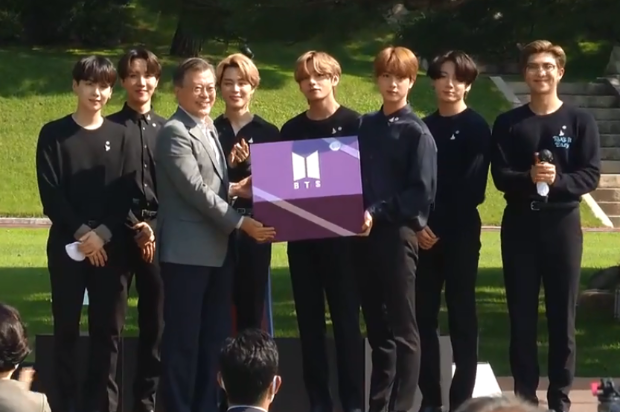
BTS meet Korean president Moon Jae-In at the gardens of the Blue House, Republic of Korea's official presidential residence, for national youth day. September 19th, 2020.

Back to the bill, just like the provisional measure mentioned earlier in the text got the moniker of "Flamengo's Provisional Measure", this one can easily be called the "BTS Bill" or the "Jin bill". It was introduced in such a timely manner and worded in such a way that it essentially applies only to BTS. The wording of the bill is extremely vague and generic. It gives the Ministry of Culture, Sports and Tourism the final word on what they deem to be "exceptional artists", it tries to establish the most subjective criteria as it can, which is "improving the country's reputation", but how can someone measure such thing objectively? Korea's minister of culture, sports and tourism, Park Yang-Woo once said he wished he could exempt BTS from enlistment if he had such power, under this bill he can at least delay it. The date where the bill was introduced also looks very opportunistic. On August 31st, it was announced that the group's first full English song, "Dynamite", has reached the top of Billboard's Hot 100 chart, the main music chart of the United States, the first time ever a Korean group had done such.thing. Four days later, the bill was introduced in the National Assembly. 

The bill is also very tricky when it comes to the possibility for other artists to ask for such delay, because BTS will be the measuring stick they will be up against. Let's give an example: could Exo member Baekhyun, who is also on enlistment clock (he already turned 28 and has until next May to enlist) ask for a delay because he has become the first Korean soloist in 19 years to sell 1 million copies in one album? He definitely could, he was also the first person since Seo Taiji to become a million seller both as a soloist and as part of a group. Sounds nice, doesn't it? But would the public react well if he asked? The answer is an easy no, because his achievements would be directly compared to BTS, and he can't win that battle. Sure he is the first million seller soloist in two decades, but you can argue that is because no BTS member has released a solo album, only mixtapes, and according to the last Gallup survey of most popular idols, six BTS members got more votes than Baekhyun. Sure, him and Exo are million sellers, but BTS had the first album in Korea to ever surpass 4 million sales. It's a losing proposition and for sure both him and his label know that, meaning in the end he will enlist when it gets close to the deadline. Nobody wants to poke the bear and be the next target of anti-idol sentiment in Korea, which has been particularly strong among the public the past couple years, with the notable exception being BTS, who are considered to be beyond idols.

The truth is, the Korean entertainment industry, and by default, the Ministry of Culture, Sports and Tourism, which oversees it, is between a rock and a hard place. In one hand, they have BTS as a powerful tool of spreading the country's soft power worldwide and as a source of revenue, therefore need to do everything to keep the group intact at all costs. On the other hand, the average idol, to the Korean public, is increasingly becoming a nobody, as the popular idols of the past move to stuff such as acting, modelling, commercials, variety or even solo music careers, moving away from their early days when they started as member of groups, but the newer ones can't emerge and replace them among the general public. Second generation idols have long moved past their initial career, third generation idols are on their last days of doing group related activities, as most main groups from this generation are 4 to 6 years old, beyond their rookie days, but fourth generation idols remain anonymous to the public, as no idol who has debuted after 2016 has made to the top 20 idols list Gallup annually publishes and that's not likely to change in 2020. The lack of new groups breaking out has led to stories of success coming from groups who are five years old already. Essentially the structure of the industry has never been so unequal, with one group getting essentially all the attention, its fellow label sidekicks sharing some scraps of its success by virtue of being BTS labelmates and everybody else is a loser, with no awards, no recognition, no public support and increasingly confined to their own fan bases, hoping to score a hit that might give them some months of fame to get an extra income before fading to irrelevance. Even the groups of the now archaic Big 3 companies have become subject to this cycle, as their oligopoly gives way to Big Hit Entertainment's monopoly.

But the higher ups have made their choice and it's only BTS and, by default, the Big Hit monopoly. In the past, SM Entertainment used to have the closest relationship with the Korean government, who still has its pension fund as an owner of a 8.5% stake on the company. These days are gone.  Just like Flamengo in Brazil has made a big effort to establish a symbiotic relationship with the Bolsonaro administration and become a propaganda tool for the brazilian federal government, Big Hit Entertainment is doing the same towards the Moon Jae-In adminstration (and potential future administrations) and turning itself into the sole content creator of Korean music (and not just pop music, but also rap, indie, rock and other genres) and spreader of the country's soft power, craving for the illusion of a western validation BTS provides them and that many others chase in vain. If two years ago the rules to revise enlistment for idols were being introduced by representatives from small political parties, today they are being introduced by a representative from the ruling political party. The group has also essentially acted as a business representative for the Korean government, and there is nothing highlighting this special relationship better than the group's performance in Saudi Arabia, booked by the president himself following the signing of bilateral agreements between the two countries, in spite of Saudi Arabia's egregious abuses towards certain groups of people, especially women, who made the bulk of BTS' fan base.
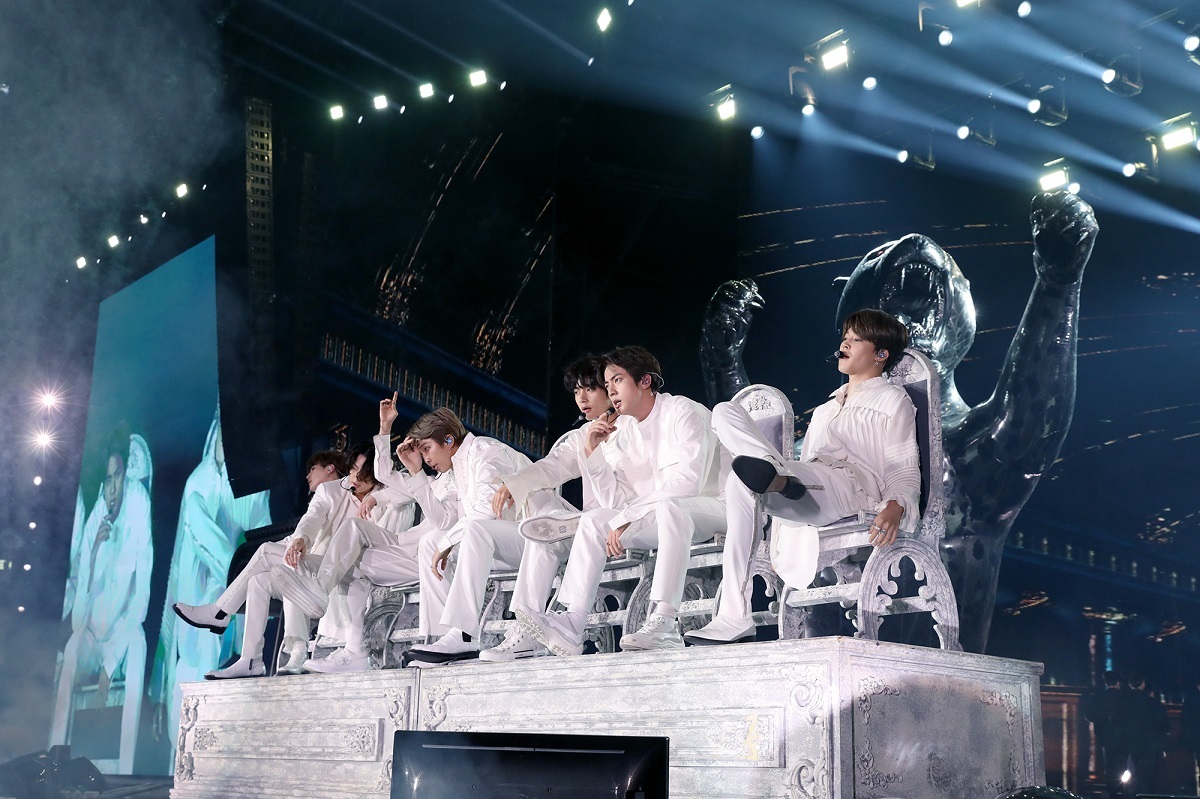
BTS perform at the King Fahd Stadium in Riyadh, Saudi Arabia. October 11th, 2019.

And make no mistake, if there is one thing lobbyists and special interests can do towards a law is stretching it and amending it for maximum profit. When Jin approaches 30 years old, is there any guarantee that the law won't just be amended to allow him and his group mates to postpone enlistment until they are 32? And then until 35, 40. Or even a full exemption. Meanwhile, the average Korean has to essentially take a 18 to 24 month break from its normal life due to a war that has officially never ended because he doesn't have a fan base to mass buy his song to a point it'll top the charts in the United States. Big Hit knows it needs to capitalize on its current wave of success from BTS to become the dominant force in the Korean music industry, and needs to extend that wave as much as it can. It's been buying other labels left and right, first longtime partner Source Music, home of girl group Gfriend, then it bought a majority of Pledis Entertainment shares, bring Seventeen, the 2nd boy band in sales only below Big Hit's own BTS. Last week, it acquired KOZ Entertainment, the label of popular korean hip-hop artist Zico. It also started trading its stocks on the market and plans to flood the k-pop market with as many groups as possible, using the BTS hype to funnel fans onto them while stffling competitors on its way to become a monopolistic force in the idol market, all because one of their idol groups happen to not be seen that way.

In conclusion, it's official, Big Hit Entertainment is slowly turning into the "government's company" and, as a consequence, BTS is becoming the "government's group". The interests of the Big Hit and BTS combo are now akin to the national interests of Korea as a country. The line between public and private has once again been blurred by the power of money and special interests. And the pressure on government officials will only increase now that the group landed its first major Grammy Award nomination. Expect the calls for exemption to only grow louder.

November 15, 2020

SM really wants you to believe NCT and SuperM are very successful

When the Gaon album chart for October was released, two results stood out, both coming from the most recent SM Entertainment boy bands. In first place, the first part of NCT's 2020 project "NCT Resonance", selling a total of 1,272,389 copies combining both of its versions (the album by itself sold 1,193,394 copies and the kit sold 78,995 copies). Another standout result were the sales of SM supergroup SuperM 2nd album, "Super One". The seven-piece group, which combines members from NCT (Taeyong, Ten, Lucas and Mark), Exo (Baekhyun and Kai) and Shinee (Taemin) ended up selling 502,445 copies. However, digging deeper onto the numbers, they just don't match in any imaginable way possible. So, let's break it down.

Starting with the most egregious one. So, according to Gaon, which tracks all shipments from Korean stores, SuperM sold a little over 500 thousand copies. However, looking at data, SM must have done massive amounts of overshipping to achieve those numbers. First, let's take a look at Hanteo, the other Korean album sales tracker. Hanteo differs from Gaon in the sense that they only report albums from certified stores that end up being sold, so their numbers will be smaller than Gaon, but usually the gaps between the two aren't that eye-popping. On the last day of October, SuperM had sold 38,071 copies of "Super One" on Hanteo certified stories. Compare to the numbers they registered on Gaon, that's a gap of 466 thousand units. So, where did those units go?

Fans usually point to the fact that SuperM is a group marketed not towards Korea but instead focusing on the United States, as the group has held numerous performances targeting that country's audience and debuted 1st on the Billboard 200 album charts with their debut EP, albeit not without controversy over the excessive use of bundles. However, their latest release saw a decrease in sales in the United States compared to their debut. SuperM's first album sold 164 thousand copies on its first week of tracking and a total of 228 thousand. For comparison, "Super One" only debuted with 101 thousand album sales in the United States, adding only 10 thousand extra units since. Even if every single one of those albums went untracked at Hanteo, that still leaves a whopping 355 thousand albums that are nowhere to be found. United World Chart, which tracks worldwide album sales, also only had SuperM charting on the album's first week, reporting sales of 120,000 copies.


SuperM for the "Tiger Inside" music video

On to NCT, similar discrepancies can be found. Last March, one of the group's subunits, NCT 127, released its second album, "Neo Zone". According to Gaon, the album sold a very round 748,000 units between its main version and kit version. That is despite the fact that no previous NCT 127 album had not even crossed the 300 thousand unit mark. Sure, massive sales growth by idol groups isn't that uncommon. However, there are so many question marks about these numbers and so much data from both NCT and other SM groups that makes these sales claims look very questionable. First, let's take a look at another SM boyband, none other than NCT's famous predecessors Exo. Its latest album, "Obsession", had sold just slightly over 601 thousand copies at Hanteo. For Gaon, the group had an increase of around 166 thousand, ended up selling 766,294 albums at the end of 2019. So in the end at the first batch, Exo sold around 18 thousand more albums than NCT 127. But what was the gap in Hanteo? One hundred and eighty-five thousand copies. Yes, that's right, 10 times the difference shown on Gaon between these two groups. And if every unit sold in the US by the end of march was ignored on Hanteo, which is hard to believe, given many fans outside Korea actually prefer to seek for Hanteo certified stores so their sales can count in Korea and in the case of fans from the United States, preferably both stores that are Hanteo certified but also show up in the Billboard 200, it still only makes up half the gap between Exo and NCT. United World Chart, by the last time "Neo Zone" charted there, had the album only at 561,000 copies sold. NCT's forgotten unit (Dream) also adds more suspicion as its april release had outsold 127 "New Zone" by the end of may in Hanteo, but Gaon instead showed a gap of 200 thousand units in favor of 127. Historically speaking, NCT Dream had always been the best-selling of the group, as it was the only one who managed to build a resemblance of a stable fan base. But with SM fully committing to the "Western Validation Trap", Dream has silently being pushed to the back to prioritize 127, which although is named for the meridian that crosses Seoul. I guess NCT 74 (New York City's longitude) would be more appropriate.

In the end, though, SM, using the power of an unhinged fandom to silence suspicions, won the narrative, as a couple months later NCT's 127 repackage album sold well enough to give the sub unit the coveted title of "million seller". They now joined an exclusive club along the likes of early day pioneers such as Seo Taiji and the Boys, g.o.d, H.O.T and Sechskies plus the most successful boy bands of the past few years in Exo, Wanna One and BTS. So how dare would someone question their success when past SM stallwarts such as TVXQ, Super Junior, Girls' Generation and Shinee never sold over 1 million copies at any of their Korean albums (although Girls' Generation did have a japanese album that crossed that threshold)? The numbers prove it!

All 23 (!!!) NCT members on teaser picture for the group's 2020 project, "Resonance". If you managed to recognize every single one of them, major props to you (and a cookie).

But SM wasn't done yet. They had an ambitious upcoming project in the works. In comes NCT 2020. For the month of October, there would essentially exist no SM Entertainment, the company had turned full-blown into NCT Entertainment. In 2018 SM had already done a similar project to this one, unifying all NCT units into one album, but the scale of NCT 2020 dwarfs what they did in 2018. It was the passing of the torch, the moment SM fully decided to make Neo Culture its one and only brand, no distractions like Exo, Red Velvet of any of their past legacy acts. Two new members were brought into the fold, increasing the count to 23, NCT now officially has the size of a FIFA World Cup roster. For the entire month, the company spent ink on press releases to point out how amazing the group's preorders had been. First they claimed 1.12 million preorders. That wasn't enough, days before the release of the Gaon monthly charts, SM doubled down, now their new number was 1.4 million. Outselling Exo's biggest album was within reach. NCT will go down as SM's biggest group in history! And there is a second part just on the way.

Gaon then released their October numbers. As said all the way back in the first paragraph, NCT ended up topping the album charts, with 1.27 million copies. Two other groups managed to sell over 1 million, making october a prolific month on that department: Blackpink (1.07 million) and Seventeen (1.06 million). They also happened to raise even more dark clouds over NCT sales. First, Seventeen, who had minimal increase from its Hanteo numbers of 958 thousand sales, which historically has been the pattern for the group, despite massive sales numbers, close to 90% of it appear on Hanteo. However, wouldn't Blackpink be on the same overshipping theory, considering Hanteo only reported 68% of their sales, which is just a few points better than NCT 63%? This is where other sources come to play. United World Chart, which tracks not only Hanteo but international sales that would mostly show up on Gaon had, at the last week of October, Blackpink at 1.117 million (actually higher than their Gaon numbers), Seventeen at 1.033 million (meaning they probably had just around 30 thousand unsold units) and NCT at... 867 thousand, which is still only 68% of their gaon numbers. On Billboard, NCT also only scored 40 thousand copies, and as I said before, even if you imply not a single one of them came from a Hanteo certified store, you still only find 71% of their sales. Blackpink, in comparison, sold 110 thousand there. So where did all those albums go? It's very suspicious.

But SM made their choice, they'll keep uttering through their PR machine that NCT are rising at a blistering pace, that SuperM is going to compete toe to toe against BTS in the United States, that sales are better than ever. They might be, when you decide to sell it to yourself just to look better. Meanwhile, public recognition and prestige of SM idols has never been as low as it's been today, as the company deals with scandals from their once popular idols. The latest Gallup result asking the most popular idols in Korea may have shown 5 idols from SM, more than their Big 3 counterparts JYP (4) and YG (2) but with a caveat: none of them debuted later than 2014, meaning they have struggled to renew their roster. Not a single NCT member shows up (and it's unlikely they will anytime soon). The last image the public has of a popular SM idol is someone going on a downward spiral like Irene and Chanyeol did recently. Aespa, their new girl group and best chance of having any big idol on a near future it's struggling because of that. All SM has to offer to the public are scandals and a group they don't care about because its concept is so confusing, with so much shuffling going on, so many units, members, it's for sure its main fatal flaw. But there is no SM Entertainment anymore, they are now Neo Culture Entertainment, and as NCT goes so does SM. Right now, it's the anchor sending them into the abyss. 

November 02, 2020

Aespa: future trend or insane idea?

On October 25th, SM Entertainment announced its first girl group in over six years. It's Aespa, a name that according to the company derives from "Avatar x Experience" and "Aspect". A week later, SM announced the debut will take place on November 17th with the single "Black Mamba". In typical recent SM fashion, the group's introduction is filled with futuristic vibes and even a twist: the members have Artificial Intelligence equivalents, as shown on this introduction video, where member Karina talks to her AI equivalent.
SM has teased a new girl group as early as 2015, with performances on the korean version of Mickey Mouse Club, as a continuation of its "SM Rookies" program, that had led to the debut of three of its trainees (Irene, Seulgi and Wendy) for SM's then brand new girl group Red Velvet in the previous year, with a fourth trainee (Yeri) joining them later. Four female trainees were on the show: Koeun, Lami, Hina and Herin. Five years (and 23 male idol debuts) later, none of them made onto the group, in a stark contrast with the male trainees, who are all current members of NCT: Mark, Donghyuck (Haechan), Jeno, Jaemin and Jisung. The Winter Garden project later in December saw the introduction of Jungyeon. In September 2016 SM introduced two chinese female trainees: Yiyang and Ningning. The last one is the only one who managed to debut for Aespa. The other trainees left one by one. 

Herin was the first to leave, as she was already out of SM by 2017 and her last activity in the Korean entertainment industry was participating on survival show "Idol School", where she finished in 22nd place and didn't make the final lineup. Next was Yiyang, who announced her departure in September 2018. Back in China, she signed a contract with former Exo member Tao's record label. Since then, Yiyang has roamed around the world of Chinese survival shows. She first debuted with girl group Legal High, formed at survival show "The Next Top Bang" in early 2019, but the group disbanded just a few months later. In 2020, she joined "Produce Camp", where another heartbreak would follow: in a lineup of seven girls, including former Gugudan member Sally, she finished 8th, with criticisms about the results being rigged. Yiyang ultimately decided for a solo career, debuting in July with the single "Listen". Jungyeon is now under SM's acting division KeyEast. Koeun and Lami seemed to be the most popular trainees but in February 2020 their names were removed from SMRookies profile page at Naver, leading to speculation about their departure. Ultimately, they won't be part of Aespa. The last domino to fall was Hina, the japanese-korean trainee, which was discovered in October to have opened an Instagram account, just a few days before Aespa debut was announced. Only Ningning survived the final cut.
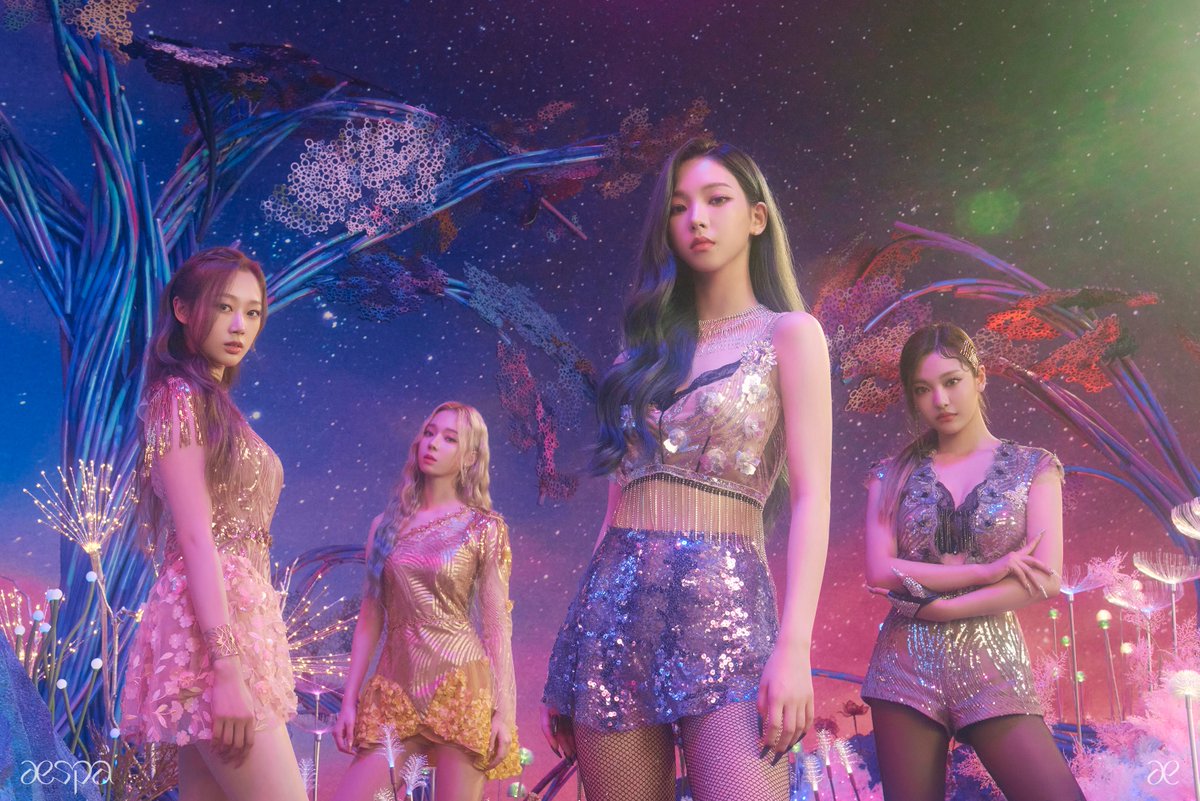
Aespa final lineup: Giselle, Winter, Karina and Ningning.

The end product is a small group, only four members, the third time in a row SM goes that route following f(x) in 2009 (five) and Red Velvet in 2014 (originally four, later five). These members are, in age order: 
  • Karina (Yoo Jimin). Korean. Born April 11th, 2000. The oldest member of the group and based on the teasers, the face of the group. Introduced as essentially the triple threat of the group. with "multiple talents in vocal, rap and dance". Second member to be introduced and protagonist of the "My Karina" teaser which presents the AI concept of the group. Trained for four years. She was the only trainee outside the SM Rookies system to appear in public, being part of Taemin's "Want" music video. She's the girl that appears for the first time at the 2:08 mark.
  • Giselle (Uchinaga Eri). Japanese. Born October 30th, 2000. The last member to be introduced, in what happened to be her 20th birthday. Deemed to have "solid rap skills" so I assume she's the main rapper of the group. Trained the shortest period of them all, just a year. The English speaker of the group.
  • Winter (Kim Minjeong). Korean. Born January 1st, 2001. First member to be introduced, considered to have "outstanding vocal and dancing skills". I assume she's the main dancer of the group. It's unclear for how long she's been a trainee but sources say at minimum three years.
  • Ningning (Ning Yizhuo). Chinese. Born October 23rd, 2002. As said before, the only trainee from the "SM Rookies" team left. Youngest member and third to be introduced. In SM's words, an "outstanding voice", which leads me to believe she's the main vocalist.
Oddly, SM did not announce any of them as the visual, despite the company's legendary history at the position. It can't even be assumed it's Karina because SM has not followed a pattern when it comes to the center and the visual being the same person or two different people. For Girls' Generation (YoonA) and Red Velvet (Irene), one member assumes both roles. Meanwhile S.E.S had Eugene as the visual but Bada as the center while f(x) had Sulli as the visual and Krystal as the center.

After the lengthy introduction it's time to talk about the concept of the group. And if you asked me, Aespa symbolizes SM's essentially burying its past aesthetics where all their past girl groups resided, despite their conceptual differences, with many relatable girls (yes even those who had more intimidating faces such as Krystal and Irene) and moving towards making the NCT futuristic universe its permanent aesthetic, moving even further with the introduction of AI equivalents of the members. The AI part is definitely the biggest differentiation Aespa has over other kpop groups but also the most concerning and riskiest aspect of Aespa's concept. Yes, SM didn't invent the virtual idol concept, after all, Hatsune Miku exists since 2007, essentially meaning they once again SM picked something from japanese pop music and presented as an original idea from theirs. Even korean pop music already has a virtual girl group project to call their own, League of Legends character inspired K/DA which actually features two real world girl group members performing voice character duties. But they will be the first ones to implement it on a permanent basis and directly linking the AIs and their real world equivalents. 
However, there are major concerns about Aespa's AI concept. The main one is that it could further enhance the objectification of idols. It's no secret that idols are essentially marketed as living versions of pretty dolls who need to be perfect at all costs and preserve an image of flawless boyfriends and girlfriends to fans (or in Bighit Entertainment's CEO nakedly capitalistic language, "customers"). They already look at idols as personal tamagotchis as it stands right now, with virtual avatars that can be owned, it will enhance fans possessive nature and it can be a easily exploited by groups like incels, who want exactly something like this: fictional portraits of young women who can satisfy their creepy needs. Essentially, Aespa is toeing a slim line between something innovative, trendsetting and higly techological and something insane, regressive and creepy.

Aesthetics wise, SM has come a long way from what they first envisioned from their SM Rookies back in 2015-16 and today. And to me, nothing exemplifies it better than the radical changes in outfits from the last girl left from that era in Ningning. When introduced, in 2016, just before turning 14 years old, Ningning first appeared on a plain outfit, a white school uniform with a pink apron and hair thrown to the front with forehead bangs, bare nails, very reminescent of the girlgroups of the early days of the second generation. Some may argue it was her age that drove this change, but looking at SM Rookies who were older than her such as Yiyang, Koeun and Hina the same pattern can be found, the vision SM had for their next girl group was most likely one that was focused on tradition, on looking back to the rookie years of their most legendary group Girls' Generation. The SM rookies of 2015-16 were dressed to perform the signature SNSD early hits such as "Into The New World", "Gee" and "Oh!", they were going to bring the audience back to a time where people uploaded videos on YouTube on a 4:3 aspect ratio. Aespa on the other hand couldn't be further away from that. The Ningning of 2020 has her hair thrown back, hairpins holding it, longer nails painted silver with hand acessories and a much more detailed outfit generally speaking. If she's covering any SNSD song it's probably "The Boys", "Mr. Mr." or "Catch Me If You Can"
Ningning as a member of Aespa in 2020 (left) and as part of SM Rookies in 2016 (right).
 
It's undeniable that k-pop has changed a lot in the four year span separating the two Ningnings, probably the most it has ever changed. On September 12th 2016, the date of her introduction, the groups that shaped the most the 3rd generation were much smaller than they were today. On the male side, BTS was just starting to breaking through, gaining popularity but far from the explosion they would enjoy after 2017. Blackpink, on the female side, were only a month old, their debut was quite popular but later that year the main girl group songs ruling the korean charts were still the standard cute songs (and so were the two biggest girl group releases of 2016). Funly enough, Aespa and Blackpink have a fair share of similarities and I would say aesthetics wise Aespa has more similarities with them than to any girl group from the "old SM", given that they have been fairly influential on shaping up new generation groups, from Everglow to Secret Number. However, the biggest one is probably how their lineup is built. Both groups have two Korean-born members (Karina and Winter, Jennie and Jisoo), a third member who is from Korean descent but foreign-born (Giselle and Rosé, which also happen to be English speakers) and a full foreign member (Ningning and Lisa). Obviously the nationality differences also tell the story about which foreign markets SM and YG targeted respectively, the foreigners of Aespa are East Asian (China and Japan), Blackpink's are Australian and Southeast Asian (Thailand). Also, it's absolutely false to call Aespa a plain copy, they are just inserted on a context where Blackpink is the main trendsetting group but at the end they are a SM group, especially the post-2016 SM. Karina may have some moments of resemblance with Jennie but she also does with Taeyeon, which despite being a product of the "old SM" is the idol they seem to look the most to replicate the success. After all Winter also has visual similarities with her and Ningning is expected to continue the elite SM. vocalist lineage that Taeyeon happens to be the main representative.
Aespa are probably under the heaviest pressure any new girl group has ever faced. They debut at a point where SM's image is taking major hits on a daily basis, with idols such as Irene and Chanyeol facing scandals. Just like Red Velvet in 2014, many see the debut of Aespa as a deflection tactic from the company to hide its scandals. Aespa can prove the doubters wrong and become a popular group, but SM is at a worst spot than compared to six years ago and that was shown on how vulnerable the group has been to rumours. Karina has been hit the hardest, with claims that she wrote text messages badmouthing every boy group with a big fandom and being a bully, which has led to massive hate against her. SM seems to trust her as the face of the project despite the allegations, since she took a central position at the group's teasers and, as shown above, essentially introduced its concept. My personal opinion is considering the timing of these controversies, carefuly crafted to hit her just as she gets close to debut, lots of it sounds like red meat to turn rabid fangirls against her from the get go and persecute her at every move. But as I said, SM has never been weaker than now and the public is currently on a bad mood with the company because of other idols wrongdoings. This defintiely affects Aespa and this definitely affects the group's ability of convincing the public who's against them now to become supportive. They will also have many challenges in regards of not making the concept too complicated or even bizarre, that has been something NCT has struggled during its career, with the unlimited members, multiple units and shuffling between them confusing even some of the most hardcore fans and limiting the group's capacity to be gain more casual listeners (which is something girl groups must have in order to survive). Right now Aespa only have the AI members and avatars as potential sources of confusion among the public and that can still lead to problems, SM better not decide to try something like keep adding new members. In case they do, they better be like After School, who didn't rock the boat much with their graduation concept once they scored a hit.

In the end SM opted to ditch the traditions that made them the main label in Korea not only for the male side with NCT and SuperM but also now with their girls in Aespa. For the former, the results have been mixed, for the latter, it remains to be seen. Historically speaking their groups have started slow and take a while to even score their first music show win, in spite of SM being the most storied record label in Korea. On the girl group side, Girls' Generation actually became the fastest to achive a win back in 2007, back when the Big 3 companies, which SM is part of, weren't as influential, thanks to their debut song becoming a sleeper hit, and it still took them 115 days, although the record has been broken six times since, with Itzy, who are very likely to be one of the main rivals for Aespa in the next generation of girl groups (if it ever takes off) now shattering it to just 9 days. Other SM groups took much longer, f(x) needed over 600 days (606) and even Red Velvet needed close to 240 (238). Now the pressure is all on Aespa's shoulders, comparisons will be inevitable and the group could either return SM back to its glory days or be a step into an irreversible many past popular labels have endured. SM debuting Aespa now gives the green light for rival labels such as YG and Bighit to start preparing their new girl groups to debut. Considering these companies have hype from past groups on their side more than SM does, by the time their groups debut Aespa has to establish itself as a top group. To make matters worse, their debut could easily be overshadowed by BTS highly anticipated comeback, which is only 3 days later.

This article closes with two videos of what SM could have gone for but passed on. A cover of "Into the New World" for animation "Shining Star". Two things are still left for Aespa: the animated characters, albeit they are not the members likenesses, just the characters of the show, and Ningning's high notes. The second is a Mickey Mouse Club performance of the original quartet of Koeun, Lami, Hina and Heri all the way back in 2015 with the question if SM should have given them a chance to be in place of Aespa. Their introduction only to never debut will forever remain one of the biggest what-ifs in the history of k-pop. Draw your conclusions.
Edit: the original version of the article had Winter as being born on december 30th, 2001. Since then it's been confirmed her date of birth is January 1st, 2001.

Brave Girls' unusual backstory and their future prospects

20 days ago, Brave Girls seemed like your typical aging idol group with no future to look forward to. The fact that they even released a son...